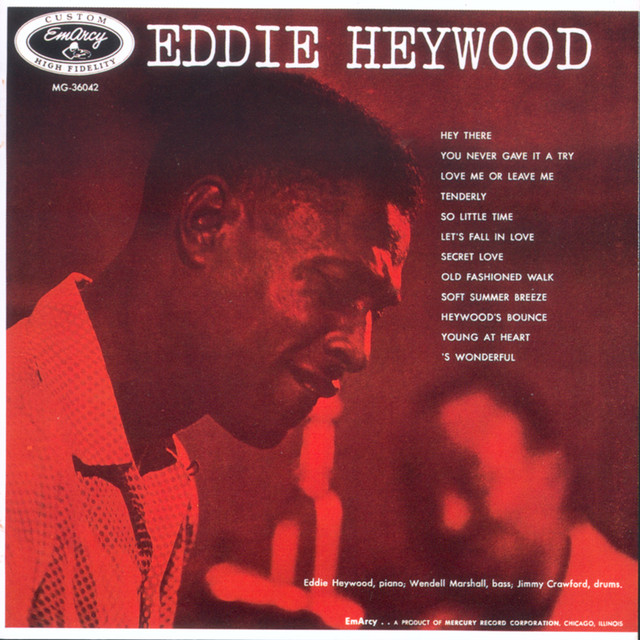
Eddie Heywood
Charts
Tracks
Playlists
SEO
Press Mentions
Overview
Not included in any known risky playlists
Monthly Listeners
Discography
Genres
Spotify has not assigned genres to this artist yet
Top Audiences
Top Listener Locations
 Los Angeles, US503New York City, US417Chicago, US374
 Mexico City, MX362
 London, GB331
Playlist Summary
Playlist Movement
No activity found
This artist's playlist additions and removals will appear here.
Biography & Metadata
The Eddie Heywood Sextet was very popular in the mid-'40s, playing melodic and tightly arranged versions of swing standards. Heywood's father, Eddie Heywood, Sr., was a strong jazz pianist of the 1920s who often accompanied Butterbeans and Susie. He taught piano to his son, who played professionally when he was 14. Heywood Jr. performed with bands led by Wayman Carver (1932), Clarence Love (1934-1937), and, after moving to New York, Benny Carter (1939-1940). Heywood led his own group from that period on, backing Billie Holiday on a few occasions starting in 1941. In 1943, Eddie Heywood took several classic solos on a Coleman Hawkins quartet date (most notably "The Man I Love") and put together his first sextet, which also included Doc Cheatham and Vic Dickenson. Their 1944 version of "Begin the Beguine" became a hit, and three years of strong success followed. During 1947-1950, Heywood was stricken with a partial paralysis of his hands and could not play at all. He made a gradual comeback in the 1950s, mostly performing watered-down commercial music in addition to composing the standard "Canadian Sunset." Despite a second attack of paralysis in the late '60s, Eddie Heywood continued performing into the 1980s. ~ Scott Yanow, Rovi
First discovered Sep 18, 2026, 6:06 AM