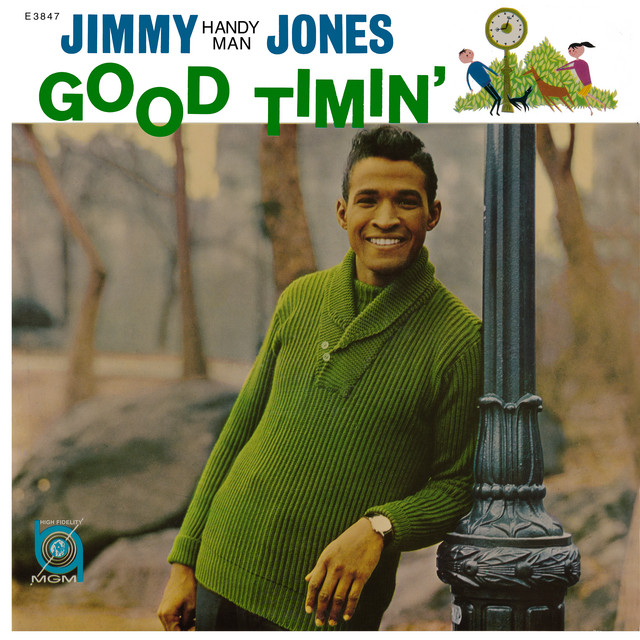
Jimmy Jones
Charts
Tracks
Playlists
SEO
Press Mentions
Overview
Not included in any known risky playlists
Monthly Listeners
Discography
Top Audiences
Top Listener Locations
 Santiago, CL1,686
 London, GB1,505
 Melbourne, AU1,267Sydney, AU1,130Brisbane, AU1,088
Playlist Summary
Playlist Movement
No activity found
This artist's playlist additions and removals will appear here.
Biography & Metadata
Best known for his 1960 R&B smash "Handy Man," Jimmy Jones sang in a smooth yet soulful falsetto modeled on the likes of Clyde McPhatter and Sam Cooke. Born in Birmingham, AL, Jones moved to New York with his family and began his entertainment career as a tap dancer. In 1954, he joined his first doo wop group, the Berliners, who soon changed their name to the Sparks of Rhythm. Jones recorded a few sides with them in 1955, then left to form his own group, the Savoys. They recorded for Savoy in 1956, then jumped to Rama and changed their name to the Pretenders (after the Platters song). The Pretenders cut sides for several labels over the next few years, a few under the name the Jones Boys, before disbanding in 1959. Tired of serving as a group leader, Jones embarked on a solo career with the MGM-owned Cub label later that year. Teamed with writer/producer Otis Blackwell, Jones recorded a song he'd written back in his Sparks of Rhythm days called "Handy Man." By early 1960, "Handy Man" had rocketed into the Top Five on both the pop and R&B charts. Jones followed "Handy Man" with another Top Ten hit, "Good Timin'," later that year. That proved to be the full extent of his major commercial success, although he kept recording through most of the '60s. He remained with Cub until 1962, scraping the lower reaches of the charts with "That's When I Cried" and "I Told You So." He recorded for Ro-Jac and Vee Jay over the next two years, and his work gradually took on a New York-style uptown soul flavor. From 1965-1967, he cut sides for Roulette, Parkway, and Bell, none of which restored his commercial standing despite some fine performances. "Handy Man," however, remained an enduring favorite, as Del Shannon and James Taylor each found significant chart success with their own versions. In 2002, thanks to Jones' continued popularity on Britain's Northern soul circuit, Castle/Sanctuary issued a double-disc anthology titled Good Timin': The Anthology. ~ Steve Huey, Rovi
First discovered Sep 3, 2026, 1:53 PM