Thomas de Hartmann
Charts
Tracks
Playlists
SEO
Press Mentions
Overview
Not included in any known risky playlists
Monthly Listeners
Discography
Top Audiences
Top Listener Locations
 Mexico City, MX180
 London, GB169
 Santiago, CL166
 Istanbul, TR150
 Paris, FR147
Playlist Summary
Playlist Movement
No activity found
This artist's playlist additions and removals will appear here.
Biography & Metadata
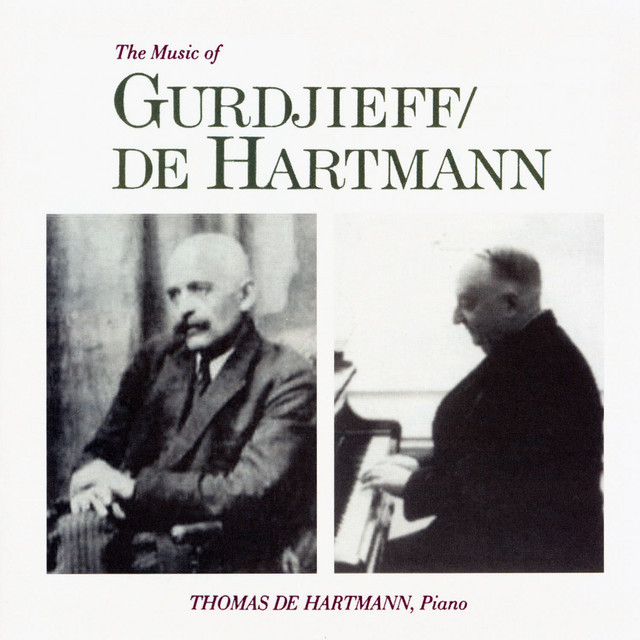
Philosopher-guru Georges Ivanovich Gurdjieff and composer Thomas de Hartmann formed a symbiotic musical relationship in the 1920s; Gurdjieff, seeking music to use in the dance elements of his teachings, would present melodies to Hartmann, who would then turn them into finished pieces for piano. The result sounds a bit like proto-minimalism, and quite a lot like the later music of Alan Hovhaness, thanks to the shared Armenian inspiration. Thomas de Hartmann was born in Khoruzhevka, Ukraine, on September 21, 1885; he died in Princeton, N.J., on March 26, 1956. Hartmann studied at the St. Petersburg Conservatory, learning composition from Taneyev and Arensky. The revolution drove him to the Caucasus, where he taught at the Tiflis Conservatory from 1919 to 1921 and first met Gurdjieff. Hartmann's wife, Olga, became Gurdjieff's personal secretary, and, as fellow "Seekers of the Truth," the couple accompanied the mystic on his travels, finally settling with him in Paris. (The couple would relocate to New York in 1951.) Hartmann provided invaluable help to Gurdjieff, transforming the melodies the mystic would hum to him into piano pieces to accompany Gurdjieff's "movements," a series of dance exercises for work on self-observation. Hartmann's own music was quite different; initially, it adhered to the Russian nationalist school and sounded something like Mussorgsky, but after 1925 it indulged in more modernistic techniques, especially polytonality and polyrhythm. His catalog includes four symphonies, several concertos, and various works for keyboard and for voice.
First discovered Oct 4, 2024, 10:00 PM