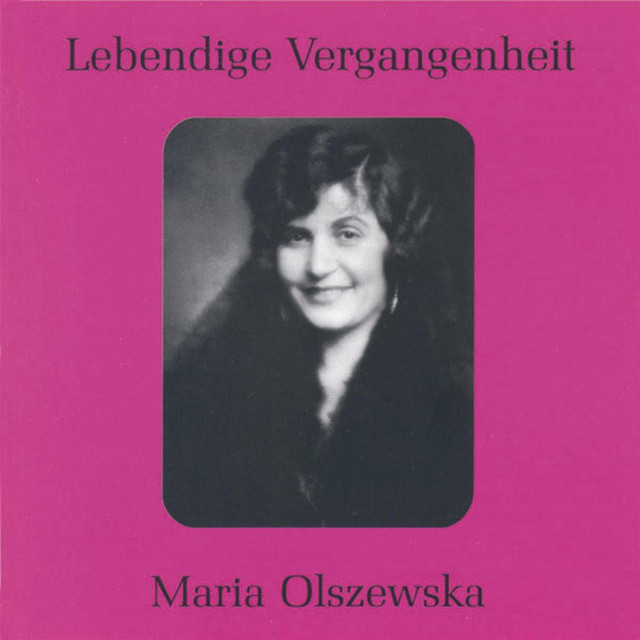
Maria Olszewska
Charts
Tracks
Playlists
Press Mentions
Google Rankings
Overview
Not included in any known risky playlists
Monthly Listeners
Discography
Genres
Spotify has not assigned genres to this artist yet
Top Audiences
Top Listener Locations
 Berlin, DE3
Playlist Summary
Playlist Movement
Event | Playlist | Botted? | Position | Track | Happened at | |
|---|---|---|---|---|---|---|
Biography & Metadata
A strikingly beautiful woman with a sumptuous voice, mezzo-contralto Maria Olszewska was a standout among the other dramatic mezzos and contraltos performing during her prime years. The very richness of her instrument sometimes led her into wild musical behavior, but when guided by the baton of an assertive conductor, she could be a magisterial artist. Among her legacy of recordings is the incomparable abridged Rosenkavalier captured in Vienna with Lotte Lehmann, Elisabeth Schumann, and Richard Mayr. Born near Augsburg, Bavaria, Maria Olszewska studied with Karl Erler in Munich and began her career as a concert singer. Subsequently, she was heard by conductor Artur Nikisch who felt that her voice was of operatic calibre and should be presented on stage. Through his recommendation, she made her debut in Krefeld in a 1917 production of Tannhäuser singing the role of a page. By 1920, Olszewska had advanced to Leipzig where her roles encompassed the larger Wagnerian mezzo parts, such as Brangäne, Fricka, and Waltraute. In Hamburg, she participated in the premiere of Erich Korngold's Die Tote Stadt, presented jointly with Cologne. The Vienna Opera engaged her in 1925 and she began to ingratiate herself with the demanding public there. Making her Covent Garden debut in 1924, Olszewska offered a Herodias described as "outstanding" as were her Waltraute, Brangäne, and Fricka. In May 1925, her collaboration with Lotte Lehmann in Lohengrin caused Ernest Newman to write that the pair "showed us what a masterpiece the second act of the opera really is." In the spring of 1927, her Carmen, like those of many other singers, failed, especially when measured against Marcel Journet's elegant Escamillo. When Bruno Walter conducted Die Fledermaus in the 1930 - 1931 season, Olszewska was the "strutting" Orlofsky. Olszewska finally was able to present her Octavian to London audiences that same year, aristocratic as the young lover, but relishing a bit of vulgarity when disguised as the wench. She remained at Covent Garden through 1933. Olszewska sang with the Chicago Opera from 1928 to 1932. There, she opened the company's last season at the venerable Auditorium with her Carmen and sang Fricka with a cast that included Frida Leider's Brünnhilde, Eva Turner's Sieglinde, and Alexander Kipnis' bass-voiced Wotan. Other roles she essayed in Chicago included Octavian, Brangäne, Ortrud, Magdalene, Katinka (in Smetana's Bartered Bride), the Third Lady Mozart's The Magic Flute), and the title role in Massenet's Hérodiade. Olszewska's Metropolitan Opera debut on January 16, 1933, induced critic W.J. Henderson to describe her as "a Brangäne of the first rank." She was cast as Amneris in the opening night of the Metropolitan's 1934 - 1935 season and sang, in addition to her repertory of Wagner roles, Azucena and Clitemnestre. In the latter part, one performance was greeted with gales of applause and cheering in the midst of the opera, an unprecedented occurrence. Music writer and conductor Robert Lawrence, writing in his 1956 book, A World of Opera, described both her physical and vocal beauty, also citing a certain restlessness that occasionally impacted her stage deportment. Her best performances, he maintained, came in productions which "immobilized her," keeping her "rooted in one spot and out of mischief." Although Olszewska sang frequently in recital, the very beauty of her voice and her propensity for lingering on vowel sounds kept her from achieving real success in that medium. On stage in Wagner and Strauss, however, she ranked with the finest artists of her era.
First discovered Sep 27, 2026, 9:07 PM