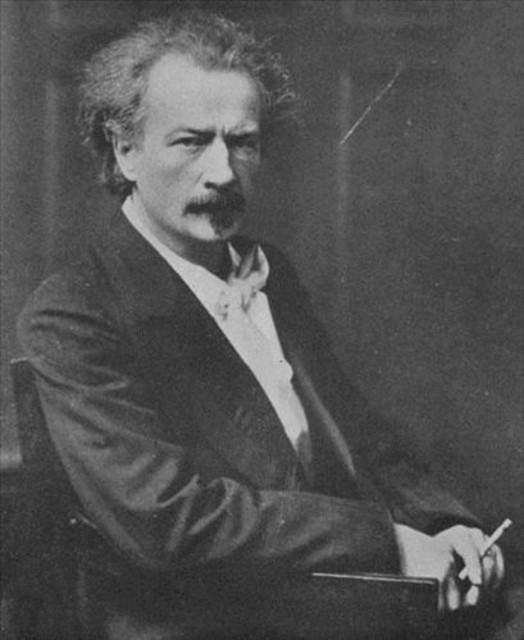
Ignacy Jan Paderewski
Charts
Tracks
Playlists
SEO
Press Mentions
Overview
Not included in any known risky playlists
Monthly Listeners
Discography
Genres
Spotify has not assigned genres to this artist yet
Top Audiences
Top Listener Locations
 Mexico City, MX587
 London, GB564
 Taipei, TW479
 São Paulo, BR435
 Sydney, AU435
Playlist Summary
Playlist Movement
No activity found
This artist's playlist additions and removals will appear here.
Biography & Metadata
Paderewski's career had a Faustian cast. His demonically driven determination to become a concert pianist, his magical audience rapport, his rapture-rife music, his political career as Poland's first prime minister, and his subsequent efforts to rescue Poland from political quagmire wear a legendary aura more often encountered in poetry. Born to a well-off, cultivated family, young Paderewski received piano lessons from an early age, entering the Warsaw Music Institute before he was 12 to study piano, harmony, and counterpoint. Upon graduation in 1878 the Institute engaged him as a piano teacher. By 1880 he was married and a year later found himself a widower and father of a son. Forsaking the musical backwater of Warsaw for cosmopolitan Berlin, Paderewski pursued composition studies between 1881 and 1883 while moving in the social orbit of the greatest musicians of the day: a young Richard Strauss, for instance, and the lionized Anton Rubinstein. Moszkowski was influential in having Paderewski's early piano pieces published. Feeling the need for further piano study, Paderewski applied in 1884 to the great Polish pianist and pedagogue Theodor Leschetizky who, upon hearing him, cried "Too late, too late!" Despite talent, Paderewski did not possess a fluent mécanique -- during three intensive years with Leschetizky, he transformed mediocre ability into a world-class technique. But well before his Vienna debut in 1888, the beginning of his career, Paderewski possessed the hypnotic, leonine, compelling presence that informed his playing and brought him world fame. This began with appearances in London and New York in 1890 and over 100 concerts in the U.S. and Canada immediately following -- a grueling schedule that was annually repeated. Other tours took him to South America, Australia, New Zealand, and South Africa, as well as the greater and lesser cities of Europe. From the late 1880s into the new century, major compositions fell from his pen -- the celebrated Minuet in G, Op. 14/1 (1887), a Piano Concerto (1888), the opera Manru (1892-1901), a Piano Sonata (1903), and a Symphony (1903-1909). Box office success was translated into good works, sponsorship of competitions, and in 1915, the Polish Victims Relief Fund. In 1919 he was chosen independent Poland's first Prime Minister, in which capacity he signed the Versailles treaty. He resumed his concert career in 1922, touring into old age and frailty to raise funds for the Polish cause in the wake of the Nazi invasion in 1939. Dying in New York in 1941, he was given a hero's burial in Arlington National Cemetery.
First discovered Aug 23, 2026, 9:08 AM