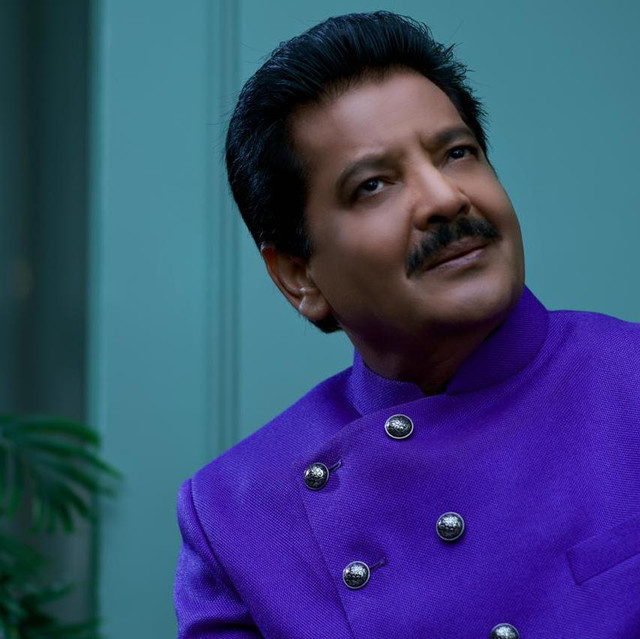
Udit Narayan
Charts
Tracks
Playlists
Press Mentions
Google Rankings
Overview
Included in high risk playlists
Monthly Listeners
Discography
Top Audiences
Top Listener Locations
 Bengaluru, IN2,423,584Hyderabad, IN2,358,608Pune, IN2,334,916Chennai, IN2,074,108Delhi, IN1,899,955
Playlist Summary
Playlist Movement
Event | Playlist | Botted? | Position | Track | Happened at | |
|---|---|---|---|---|---|---|
Biography & Metadata
Through the '90s, Udit Narayan was the closest rival of Kumar Sanu for the title of most popular male playback vocalist in Indian cinema -- no small feat, since films remain the primary vehicle for disseminating popular music to the Indian public. Though he wasn't quite as prolific as Sanu, Narayan boasted one of the most distinctive voices and original singing styles the music-reliant film industry had seen since the glory days of Mohammed Rafi (Narayan's primary initial influence) and Kishore Kumar. Narayan was born in the village of Mithla Nagri in Janakpur, near the border of Nepal; his father was a farmer and his mother a singer, and she encouraged him to pursue music as a career. For most of the '70s, Narayan worked as a singer on Nepalese radio in Kathmandu, performing Nepalese and northern Indian folk songs. In 1978, he went to Bombay -- the cinema capital of India -- on a music scholarship, and trained for eight years as a classical vocalist. During that time, he also attempted to make contacts in the film industry. Rajesh Roshan gave him an opportunity to sing in the 1980 film Unnees Bees with his hero Mohammed Rafi; he also got the opportunity to sing a small part for renowned music director R.D. Burman in another film, but despite those small victories, the '80s were by and large a decade of struggle and rejection for Narayan. All of that changed, however, in 1989. Narayan hooked up with the up-and-coming composer duo Anand-Milind, who were scoring a film for an up-and-coming young actor named Aamir Khan. Narayan's youthful-sounding voice seemed a perfect match for Khan's screen presence, and he was hired along with female vocalist Alka Yagnik to handle most of the soundtrack, including the centerpiece number "Papa Kehte Hain." Titled Qayamat Se, Qayamat Tak, the film became a blockbuster success, catapulting virtually everyone involved into stardom. Seemingly out of nowhere, the previously unknown Narayan won the 1989 Filmfare Award (sort of an Oscar and Grammy combined) for Best Male Vocalist, thanks to "Papa Kehte Hain," which had become a huge hit among Indian teens. All of a sudden, after years of hard work and obscurity, Narayan was a star. Work -- and further hit songs -- came Narayan's way at a fast and furious pace. His next film, Dil, was another hit, solidifying his newfound reputation; he sang for nearly all of India's major music directors, and dubbed songs for a wide variety of actors (a challenge for some singers whose voices may not fit the characters they are supposed to maintain). In 1995, Narayan broke Kumar Sanu's string of five straight Filmfares with his own second, for the song "Mehndi Laga Ke Rakhna" from Dilwale Dulhaniya Le Jaayenge. He won a second straight Filmfare the following year for "Pardesi Pardesi" from Raja Hindustani. Among his most notable achievements of the late '90s, Narayan recorded with the legendary Lata Mangeshkar for the film Dil To Pagal Hai, scored some of his biggest hits from the film Kuch Kuch Hota Hai, and won a fourth Filmfare for "Chaand Chupa" (from Hum Dil De Chuke Sanam). Additionally, Narayan watched his young son Aditya become an in-demand filmi vocalist himself, dubbing in song parts for child actors. ~ Steve Huey, Rovi
First discovered Jul 23, 2025, 4:33 PM