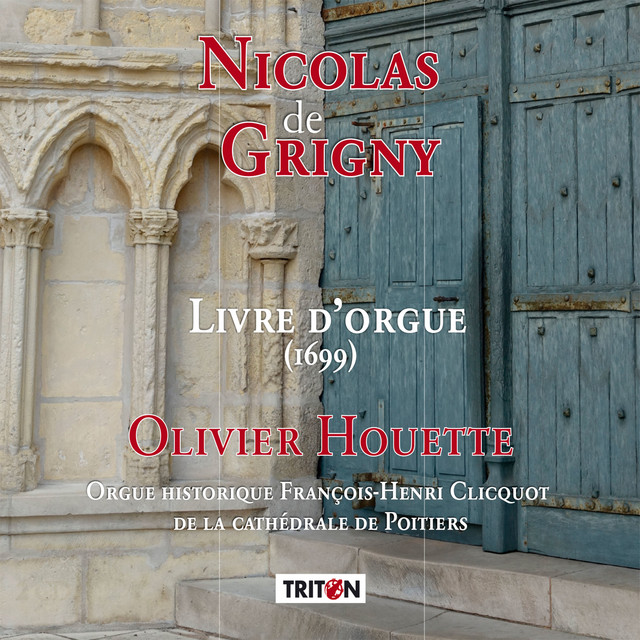
Nicolas de Grigny
Charts
Tracks
Playlists
SEO
Press Mentions
Overview
Not included in any known risky playlists
Monthly Listeners
Discography
Genres
Spotify has not assigned genres to this artist yet
Top Audiences
Top Listener Locations
 London, GB19
 Paris, FR19
 Madrid, ES10Barcelona, ES9
 Berlin, DE9
Playlist Summary
Playlist Movement
No activity found
This artist's playlist additions and removals will appear here.
Biography & Metadata
Despite his short life, Nicolas de Grigny was the finest French organist-composer of his period. He was something of a French Bach, in that he showed little interest in innovation but brought the established forms of organ music to their greatest point of refinement. Indeed, Bach seems to have admired Grigny's compositions, having copied them all out for his personal study. Grigny came from a long line of musicians; among them, his grandfather, father, and an uncle were organists in Reims. Nicolas de Grigny seems to have gotten his professional start in Paris; records show that he was organist at the abbey church of St. Denis from 1693 to 1695. Perhaps he got this job through a family connection; his brother was a sub-prior there. He also may have studied with Lebègue during this time. By 1696 he had moved with his Parisian bride back to Reims, where he became organist at the cathedral. He served there for the rest of his life, which lasted little past his thirty-first birthday. Grigny's published works include five hymns, the four sections of the Ordinary of the Mass, and four other items. Each of the Mass sections begins with a movement quoting plainsong in one voice, accompanied by Grigny's own animated harmonizations. There follows in each case a fugal movement employing a fragment of the plainsong already quoted, and then other small movements usually not related to the chant material. His use of counterpoint and even simple harmonizing voices is quite rich, as are his melodic embellishments, and he exploits the organ's various registers at every opportunity, giving the pedals a particular workout. Grigny groomed no successors, so his music both defines its era, and brings it to a remarkable close.
First discovered Aug 21, 2026, 2:11 AM