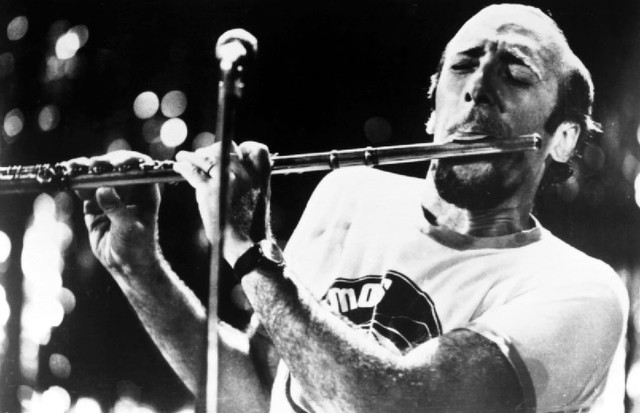
Herbie Mann
Charts
Tracks
Playlists
SEO
Press Mentions
Overview
Not included in any known risky playlists
Monthly Listeners
Discography
Genres
Spotify has not assigned genres to this artist yet
Top Audiences
Top Listener Locations
 São Paulo, BR16,851Rio de Janeiro, BR8,434Belo Horizonte, BR4,253Brasília, BR4,198
 London, GB3,301
Playlist Summary
Playlist Movement
No activity found
This artist's playlist additions and removals will appear here.
Biography & Metadata
Herbie Mann played a wide variety of music throughout his career. He became quite popular in the 1960s, but in the '70s became so immersed in pop and various types of world music that he seemed lost to jazz. However, Mann never lost his ability to improvise creatively as his later recordings attest. Herbie Mann began on clarinet when he was nine but was soon also playing flute and tenor. After serving in the Army, he was with Mat Mathews' Quintet (1953-1954) and then started working and recording as a leader. During 1954-1958 Mann stuck mostly to playing bop, sometimes collaborating with such players as Phil Woods, Buddy Collette, Sam Most, Bobby Jaspar, and Charlie Rouse. He doubled on cool-toned tenor and was one of the few jazz musicians in the '50s who recorded on bass clarinet; he also recorded a full album in 1957 (for Savoy) of unaccompanied flute. After spending time playing and writing music for television, Mann formed his Afro-Jazz Sextet, in 1959, a group using several percussionists, vibes (either Johnny Rae, Hagood Hardy, or Dave Pike) and the leader's flute. He toured Africa (1960) and Brazil (1961), had a hit with "Comin' Home Baby," and recorded with Bill Evans. The most popular jazz flutist during the era, Mann explored bossa nova (even recording in Brazil in 1962), incorporated music from many cultures (plus current pop tunes) into his repertoire, and had among his sidemen such top young musicians as Willie Bobo, Chick Corea (1965), Attila Zoller, and Roy Ayers; at the 1972 Newport Festival his sextet included David Newman and Sonny Sharrock. By then Mann had been a producer at Embroyo (a subsidiary of Atlantic) for three years and was frequently stretching his music outside of jazz. As the '70s advanced, Mann became much more involved in rock, pop, reggae, and even disco. After leaving Atlantic at the end of the '70s, Mann had his own label for awhile and gradually came back to jazz. He recorded for Chesky, made a record with Dave Valentin, and in the '90s founded the Kokopelli label on which before breaking away in 1996, he was free to pursue his wide range of musical interests. Through the years, he recorded as a leader for Bethlehem, Prestige, Epic, Riverside, Savoy, Mode, New Jazz, Chesky, Kokopelli, and most significantly Atlantic. He passed away on July 1, 2003, following an extended battle with prostate cancer. His last record was 2004's posthumously released Beyond Brooklyn for Telarc. ~ Scott Yanow, Rovi
First discovered Aug 19, 2026, 2:55 PM