Hespèrion XXI
Charts
Tracks
Playlists
Press Mentions
Google Rankings
Overview
Not included in any known risky playlists
Monthly Listeners
Discography
Top Audiences
Top Listener Locations
 Madrid, ES1,646
 Mexico City, MX1,402
 Istanbul, TR1,165Barcelona, ES948
 Paris, FR875
Playlist Summary
Playlist Movement
Event | Playlist | Botted? | Position | Track | Happened at | |
|---|---|---|---|---|---|---|
Biography & Metadata
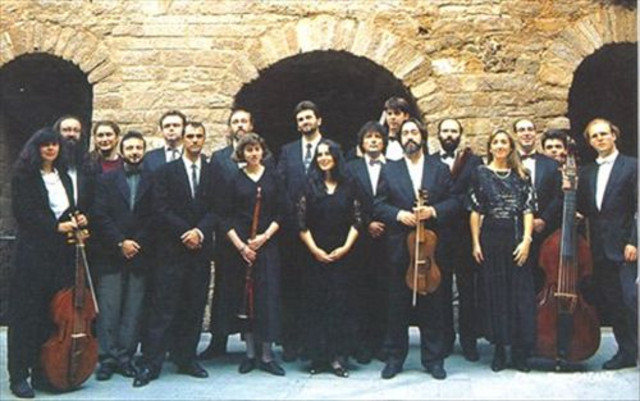
Spain's Hespèrion XXI is noted for its broad exploration of early music from the medieval to the Baroque periods, some of it from Spain and Portugal but also from the rest of Europe and even beyond. The group, often performing with the larger Capella Reial de Catalunya, is regarded as one of Europe's top early music ensembles. Hespèrion XXI was founded in 1974 as Hespèrion XX by viol player Jordi Savall, singer Montserrat Figueras, plucked stringed instrument player Hopkinson Smith, and flutist and percussionist Lorenzo Alpert. Savall has remained the director of the group, which renamed itself Hespèrion XXI at the beginning of the 21st century. The term "Hespèrion" came from "Hesperia," the ancient Greek term for the Iberian and Italian peninsulas (and ultimately from "Hespera," west). Hespèrion XXI's initial intent was to specialize in Spanish and Portuguese music, but the group soon expanded into medieval and Renaissance music of other countries, recording music of John Dowland, J.S. Bach, and Samuel Scheidt, among many others. Hespèrion XXI both emphasizes scholarly research in preparing its performance scores and has committed itself to broadly accessible interpretation of unfamiliar music; the group's albums are accompanied by extensive notes by Savall, appearing in as many as six languages that put the music in deep historical context and that, in the CD era, were often enclosed in a hardback bookbinding. The group's musicians were encouraged to improvise according to what was known about performance practices of the time. With Savall's longtime tenure as a professor at the Basel Conservatory giving him access to a wide range of players, Hespèrion XX/XXI has grown, and the group's repertory has expanded as a result. Normally, the group has about 12 players, but this may expand or contract according to the repertory. In 1987, Hespèrion XX became part of La Capella Reial de Catalunya, Savall's larger ensemble oriented toward choral and vocal works, but it has maintained an independent existence, offering as many as 100 concerts annually. The group has toured worldwide, including in Arab countries rarely visited by Western ensembles, and it has won numerous annual major awards. An early and characteristic recording came in 1999 when the group backed Montserrat Figueras on the album Diaspora Sefardi: Romances & Música Instrumental. Hespèrion XXI has continued to record prolifically for Savall's Alia Vox label, often, as with other Savall groups, issuing recordings centered on historical events or specific cultural contexts. An example was 2012's Erasmus von Rotterdam: In Praise of Folly. Savall's interests have increasingly often turned toward the music of the non-Western world (and its links to the West): 2018 saw the release of Bailar Cantando: Fiesta Mestiza en Peru, and in 2019, Hespèrion XXI issued Ibn Battuta: The Traveler of Islam. By 2023, when Hespèrion XXI was featured with the Mediterranean/Middle Eastern Ensemble Orpheus 21 on the album Oriente Lux: Dialogue des âmes, the group's recording catalog comprised some 50 items. ~ James Manheim, Rovi
First discovered Aug 22, 2026, 3:49 PM