Dimitri Tiomkin
Charts
Tracks
Playlists
SEO
Press Mentions
Overview
Not included in any known risky playlists
Monthly Listeners
Discography
Genres
Spotify has not assigned genres to this artist yet
Top Audiences
Top Listener Locations
 London, GB375
 Madrid, ES292
 Dallas, US220Los Angeles, US211
 Sydney, AU206
Playlist Summary
Playlist Movement
No activity found
This artist's playlist additions and removals will appear here.
Biography & Metadata
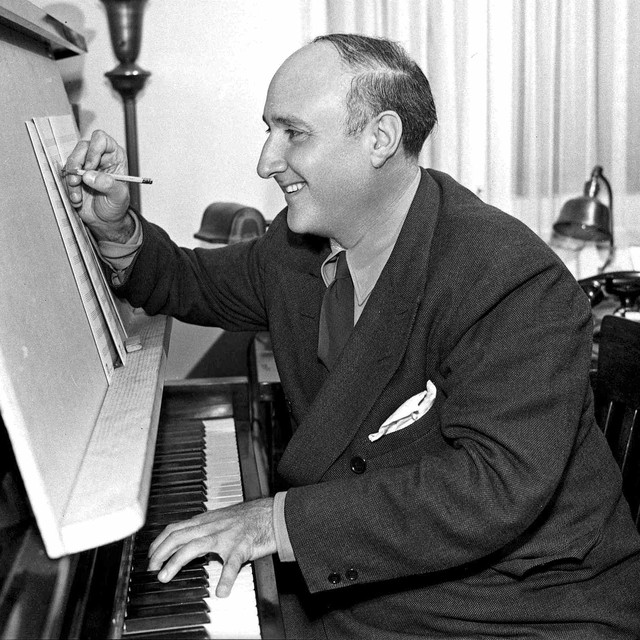
Dimitri Tiomkin was one of the most successful European emigre musicians in Hollywood. He studied at the St. Petersburg Conservatory under Alexander Glazunov and Felix Blumenfeld and, fleeing post-revolutionary Russia, moved to Berlin, where he studied with Busoni and established a duo-piano act with fellow St. Petersburg alumnus Michael Kariton. He made his debut as a concert pianist with the Berlin Philharmonic in Liszt's Concerto for piano in A major in 1923, after which Tiomkin came to America on a vaudeville tour. That led to work with a dance company directed by Albertina Rasch, whom he subsequently married. He immersed himself in the music of Richard Rodgers, Irving Berlin, Jerome Kern, and George Gershwin, and a meeting with Gershwin led to Tiomkin's playing the European premiere of the latter's Concerto in F at the Paris Opera in 1928. By 1929, the couple had moved to Hollywood, and Tiomkin joined the movie industry. His early assignments were generally unsatisfying and all connected with failed pictures. In 1937, he saw his first success with Frank Capra's Lost Horizon -- the hit movie was enhanced by Tiomkin's rich melodies and thick-textured orchestral and choral writing, evocative of late Russian romanticism. Although he was familiar with the developments of twentieth century music, Tiomkin was most successful working in a late Romantic idiom. In 1948, he scored Howard Hawks' Red River, his first western -- by this time, Tiomkin was so steeped in American music that his melodies seemed as old as the plains. His music for another western, Stanley Kramer's production of High Noon (1952), literally saved the movie, which had tested terribly in previews without music -- the title song became a hit single twice, and the song and score earned Tiomkin two Academy Awards. In contrast to High Noon was his harsh, dissonant score for Hawks' The Thing (1951), which was groundbreaking in its use of distorted instrumentation, setting the tone for science fiction music for 50 years. Tiomkin spent the rest of his career dividing his time between epic dramas, including Hawks' Land of the Pharaohs (where he reprised his Lost Horizon score) and George Stevens' Giant, and westerns, including Hawks' Rio Bravo (where he reprised his Red River score with words), and John Wayne's The Alamo, taking a detour into television for the theme from Rawhide. His last major scores were for the European-made epics 55 Days at Peking and Fall of the Roman Empire.
First discovered Aug 25, 2026, 12:26 PM