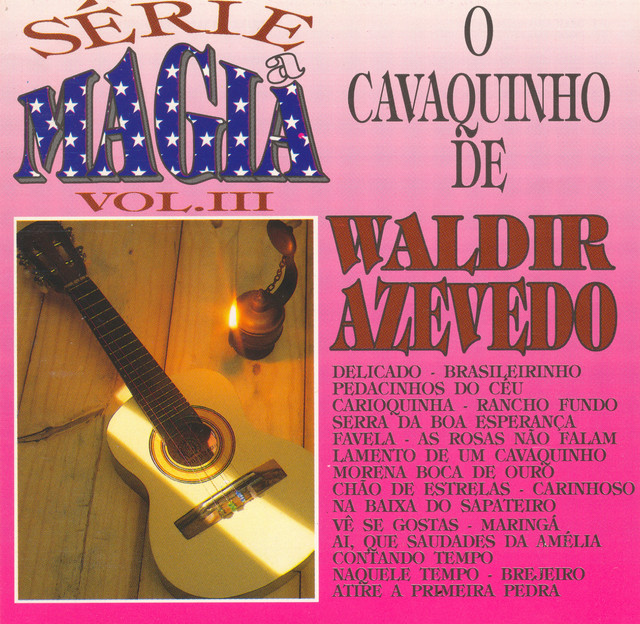
Waldir Azevedo
Charts
Tracks
Playlists
Press Mentions
Google Rankings
Overview
Not included in any known risky playlists
Monthly Listeners
Discography
Genres
Spotify has not assigned genres to this artist yet
Top Audiences
Top Listener Locations
 São Paulo, BR4,381Itabuna, BR3,722Rio de Janeiro, BR2,134Brasília, BR1,372Belo Horizonte, BR1,278
Playlist Summary
Playlist Movement
Event | Playlist | Botted? | Position | Track | Happened at | |
|---|---|---|---|---|---|---|
Biography & Metadata
Waldir Azevedo was the most successful composer and musician of the genre choro, and maybe of all Brazilian music, in relative terms. A pioneer in the exploration of the instrument cavaquinho, his themes, simple and communicative, always succeeded in capturing the attention of listeners. Azevedo recorded 132 compositions in diverse genres, 50 78s, and 20 LP's (including one shared with his rival Jacob do Bandolim). His songs were also recorded in Japan, Germany, and the U.S.A., where the Percy Faith Orchestra's recording of "Delicado" sold over a million copies. Azevedo's first instrument was the flute, at age seven. Soon he also learned mandolin and then cavaquinho. Learning the six- and seven-string violões (acoustic guitars), he performed in public for the first time on the flute, in 1933. His wish was to become an aviator, but his cardiac condition impeded it. Singing and playing the tenor violão he joined the group Águias de Prata, which performed at the Copacabana Palace and recorded an album for Victor. Meanwhile, he was employed at Light Company. As Dilermando Reis needed a cavaquinho player for his regional, Azevedo was auditioned at Rádio Clube right in the middle of his honeymoon and got the job, holding the position for two years. In 1947, Reis departed for his solo career and Azevedo took the leadership of the regional. He accompanied hundreds of artists, from novice to star, and began to draw the attention of the listeners towards his own compositions. As the recording company Continental was in the same building, he was invited to record his piece "Brasileirinho," after several radio performances. The invitation coincided with the departure of Jacob do Bandolim, his biggest rival, from Continental to RCA Victor. "Brasileirinho," released in December, was a huge success from the start. The '50s also were productive for Azevedo, who recorded other big hits like the baião "Delicado," the choro "Pedacinhos do Céu," "Chiquita," and "Vê se Gostas," among others. Azevedo toured South America and Europe for 11 years, including two tours sponsored by the Brazilian diplomatic service Itamarati, the Caravanas da Música Brasileira. In London, England, he appeared in a BBC show broadcast to 52 countries. In 1964, a car accident killed his daughter, which pushed him into a dark period of depression. In 1967 he learned to read and write music. In 1971, living in Brasília DF, he suffered an accident in which he almost lost his third finger and had to abandon music for one and a half years. After several surgeries, he returned to live performance in 1974, at the Clube do Choro of Brasília. Enjoying the choro revival of the '70s, Azevedo soon began to record again and to perform in TV shows, such as Sabor bem Brasil, Seis e Meia, Pixinguinha, Choro na Praça, and others. In November 1989, 30 years of success of "Brasileirinho" was remembered in a tribute show at São Paulo's Teatro Municipal. Along with Azevedo played Paulinho da Viola, Ademilde Fonseca, Paulo Moura, and others. ~ Alvaro Neder, Rovi
First discovered Aug 20, 2026, 5:19 PM