Jacqueline du Pré
Charts
Tracks
Playlists
SEO
Press Mentions
Overview
Not included in any known risky playlists
Monthly Listeners
Discography
Top Audiences
Top Listener Locations
 London, GB8,571
 Mexico City, MX6,399
 Madrid, ES5,370
 Sydney, AU4,557
 New York City, US4,143
Playlist Summary
Playlist Movement
No activity found
This artist's playlist additions and removals will appear here.
Biography & Metadata
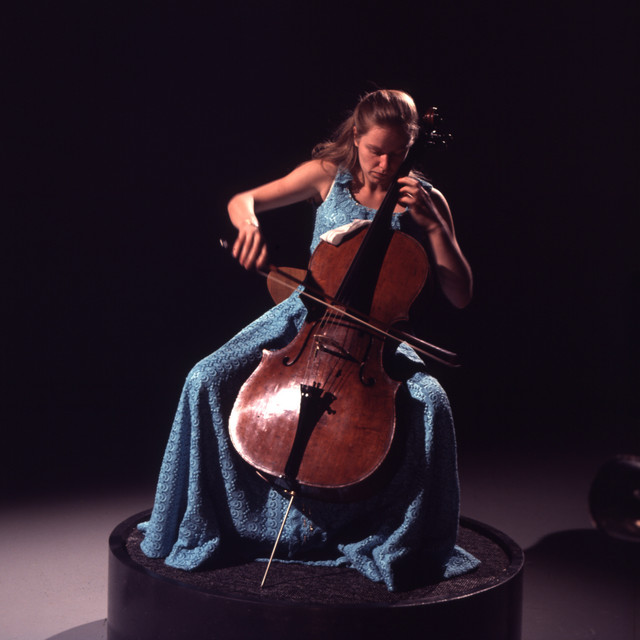
Her story is one of the most legendary of all twentieth century musicians' stories, and also, one of the most tragic. Cellist Jacqueline Du Pré, born on January 26, 1945, in Oxford, England, to Derek and Iris Du Pré. (Despite the family name, Derek Du Pré was not French, but rather of British Channel Island ancestry; he could trace his lineage back to the Norman Conquest). She blossomed young and achieved international fame in a few short years during the mid-1960s, during which same time she joined Daniel Barenboim in one of history's most celebrated musical marriages. But her career was shattered in the early 1970s -- not even a decade into its maturity -- by multiple sclerosis. It was through her mother Iris, a pianist and teacher, that young Jacqueline was first introduced to music. She was given a cello at age four, began lessons with Alison Dalrymple at the London Violoncello School some months later, and by age ten was studying with William Pleeth, eventually enrolling as his student at London's Guildhall School of Music. While at Guildhall she was the recipient of virtually all the school's internal awards and recognitions, meanwhile taking lessons with Pablo Casals in Switzerland and Paul Tortelier in Paris. Graduating from Guildhall in 1960, she began to make her first true professional appearances, appearing with the BBC Orchestra in 1961 and performing the Elgar concerto at Wigmore Hall in London that same year, playing on a 1672 Antonio Stradivarius cello presented to her by an anonymous patron. Further concert appearances and, in particular, a series of recordings quickly established her as the premiere young cellist of her generation, and, in many minds, the premiere British-born performer to have appeared in many generations. In 1964, she was given the Davidoff Stradivarius (now in the possession of Yo-Yo Ma), and it was with this instrument that she made her Carnegie Hall debut on May 14, 1965. She engaged in further studies with Mstislav Rostropovich around that same time, even taking the final examination at the Moscow Conservatory in 1966 -- the same year she met Daniel Barenboim, whom she married the following June. Du Pré's personal and professional relationship with Barenboim opened up whole new opportunities for chamber music experience, and her collaborations with such up-and-coming luminaries as Pinchas Zukerman and Itzhak Perlman sold thousands of both recordings and tickets (and, eventually, videos). In 1971, Du Pré began to feel that all was not well with her body and, thus, her playing, and she took the entirety of the following year off. In 1973 she was diagnosed with multiple sclerosis, and, except for a pair of performances that year and some sonata recordings (Chopin and Franck), her career as a performer was over. She remained active as a teacher, however, for many years afterwards. In 1976, she was awarded the O.B.E., and in 1982 she was named Musician of the Year by the Incorporated Society of Musicians. She passed away on October 19, 1987, at the age of 42. Jacqueline Du Pré's physical gift for her instrument was prodigious; but it was her sheer joy in music making that endeared her to the world's audiences. Although some found her physical involvement during performance distasteful, few could find reason to complain about the sonic result. The scintillating, rapturous tone she produced was positively intoxicating, and remains so today through recordings. Her renditions of the Elgar and Dvorák concertos, and of the Schumann concerto, are especially beloved.
First discovered Sep 12, 2026, 3:31 AM