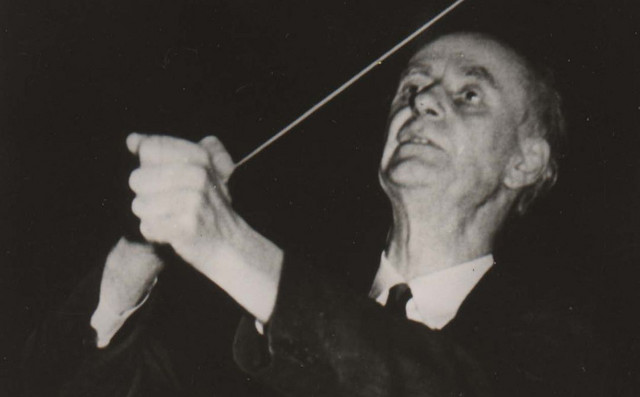
Wilhelm Furtwängler
Charts
Tracks
Playlists
Press Mentions
Google Rankings
Overview
Not included in any known risky playlists
Monthly Listeners
17,394 – 17,583
Discography
Top Audiences
Top Listener Locations
 Madrid, ES276
 Berlin, DE265
 London, GB250
 Paris, FR198
 Mexico City, MX190
Playlist Summary
Playlist Movement
Event | Playlist | Botted? | Position | Track | Happened at | |
|---|---|---|---|---|---|---|
Biography & Metadata
Although born in Berlin, conductor Wilhelm Furtwängler spent his childhood in Munich, where his father was a professor. After his talents were recognized at an early age, he was removed from school and educated privately. Furtwängler's teachers included the composer Joseph Rheinberger and the conductor Felix Mottl. By the age of 17, the young musician had written numerous works and had his conducting debut three years later with the Kaim Orchestra, where he directed the opening Largo from his own first symphony, Beethoven's overture Die Weihe des Hauses, and Bruckner's Ninth Symphony. The ambivalent response to his music and the financial instability that composition offered caused him to focus his energies on conducting. Furtwängler's first position was at the Breslau Stadttheater in 1906 and 1907. He went to Zurich the next season, followed by an apprenticeship at the Munich Court Opera under the auspices of his teacher Mottl. From 1911 to 1921, Furtwängler served as music director of various ensembles in Lübeck, Mannheim, Frankfurt, and Vienna. From 1920 to 1922, he served as conductor of the Berlin Staatskapelle. At the age of 35, the conductor took the baton at the celebrated Berlin Philharmonic and concurrently held the same position at the Leipzig Gewandhaus Orchestra, where he remained until 1928. Furtwängler led the New York Philharmonic from 1927 to 1929, but eventually declined an offer to remain there. It was during those years that Furtwängler was appointed music director of the Vienna Philharmonic. As the 1920s drew to a close, he held positions throughout Europe, including those at the Bayreuth and Salzburg festivals (1931-1932) and the Berlin State Opera (1933). In 1932, he was awarded the Goethe Gold Medal. When the Nazis came into power in 1933, Furtwängler strongly and publicly opposed the Nazi agenda, despite pride in his German heritage, and refused to give the Nazi salute, even in Hitler's presence. In 1934, when Hindemith's Mathis de Maler was banned by the Nazi party, Furtwängler unilaterally resigned from all of his posts, aided numerous Jewish musicians under Nazi persecution, and refused to conduct in Nazi-occupied areas. Furtwängler eventually fled to Switzerland at the suggestion of Albert Speer. When, in 1936, the New York Philharmonic offered him the position of music director, he was dissuaded from accepting the position by anti-Nazi sentiment. After the war's conclusion, the Allied command cleared Furtwängler of charges of being a Nazi sympathizer, although the American government did not "denazify" Furtwängler until 1946. In 1949, the Chicago Symphony Orchestra courted the German conductor, but its board of directors quickly withdrew its offer under the heavy and largely unjustified criticism from the orchestra's musicians. Always welcomed in Europe, Furtwängler enjoyed continued success throughout the region. While uninterested in recording live performances, citing the impossibility for technology to capture a mood or aesthetic, he was responsible for countless recordings, most of which were made after the war. His dedication to the works of Beethoven was unsurpassed, and his enthusiasm towards the contemporary compositions of the time impressive, evidenced by his aggressive programming. Furtwängler's idiosyncratic approach to the repertoire and spontaneous interpretations were unique to say the least. Furtwängler remained a popular artist and kept a busy schedule conducting throughout Europe until his death in Baden-Baden in 1954. According to his second wife Elisabeth Ackermann, he died a darkened and melancholy man, troubled by the atrocious history his beloved Germany had written.
First discovered Sep 4, 2026, 5:57 AM