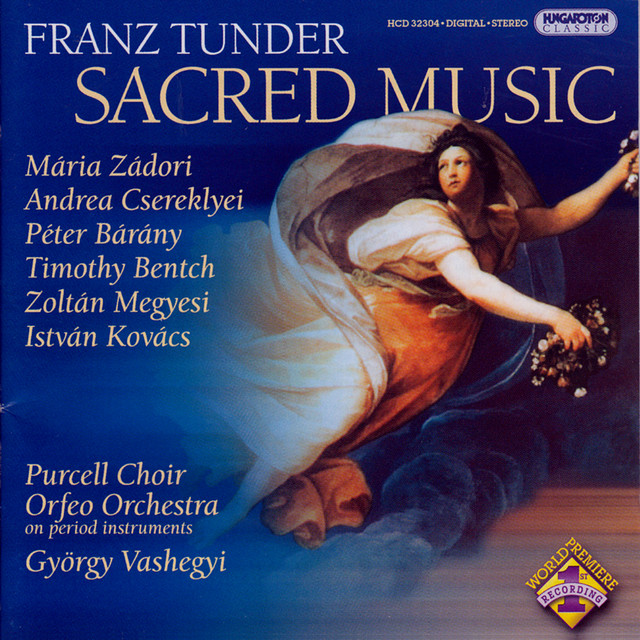
Franz Tunder
Charts
Tracks
Playlists
SEO
Press Mentions
Overview
Not included in any known risky playlists
Monthly Listeners
Discography
Genres
Spotify has not assigned genres to this artist yet
Top Audiences
Top Listener Locations
 Sydney, AU39
 Berlin, DE36
 Amsterdam, NL26
 Paris, FR22
 Madrid, ES19
Playlist Summary
Playlist Movement
No activity found
This artist's playlist additions and removals will appear here.
Biography & Metadata
Franz Tunder was a significant and influential figure in early North German Baroque music. Although many histories place his birth in Bannersdorf on the Island of Fehmarn, most recent research indicates Tunder was born in Lübeck. In his youth, Tunder traveled extensively, studying music in Burg and in Copenhagen, where in the latter instance his mentor was eminent Danish composer Melchior Borchgrevinck. When Tunder was named organist to the court of Duke Friedrich III of Holstein-Gottorf, part of his training included traveling to Florence to study with Italian master Girolamo Frescobaldi. In 1641, Tunder assumed the prestigious post of organist at the Marienkirche in his hometown of Lübeck, remaining in the position until his death 26 years later at the age of about 56. When Tunder died, his post was taken over by Dietrich Buxtehude, who also married one of Tunder's daughters, following a custom common among successor organists in seventeenth century Germany. While Tunder's surviving output is modest, it is nonetheless potent -- 15 works for organ, including chorale settings and preludes, an orchestral sinfonia that once belonged to a motet (now lost), and 17 vocal "concertos" that are classified under the general heading of "Abendmusiken." It is this last group of works that represents Tunder's most important accomplishment. In 1646, Tunder, at his own expense, mounted the earliest known series of public concerts held in Germany. Given in the evening, the series originally began merely as concerts of organ music held in the Marienkirche, but ultimately Tunder added singers and a small band of violins to the group, bringing about the form of "abendmusic" -- evening music. Scored for solo voices and a small orchestra with organ, the texts for the concerti, in Latin and German, are all sacred, yet none of these pieces was appropriate for use in church services. They were composed merely to entertain a population with rather pious tastes. Buxtehude would continue abendmusic format after Tunder's death and raise it to such a high artistic standard that he is often misidentified as the originator of this style. However, Franz Tunder was there first, and his remaining music exemplifies the initiation of the basic North German Baroque style that in a few generations would lead to Johann Sebastian Bach, rooted in the sturdy tunes of Reformation hymnals, yet seasoned with an Italian flavoring and approach to instrumentation.
First discovered Sep 5, 2026, 7:26 PM