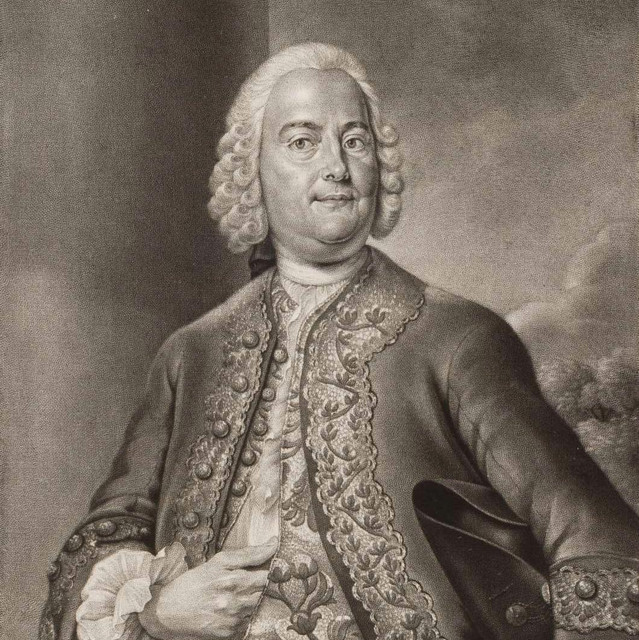
Carl Heinrich Graun
Charts
Tracks
Playlists
SEO
Press Mentions
Overview
Not included in any known risky playlists
Monthly Listeners
Discography
Genres
Spotify has not assigned genres to this artist yet
Top Audiences
Top Listener Locations
 London, GB166
 Amsterdam, NL153
 Berlin, DE144
 Madrid, ES110Barcelona, ES86
Playlist Summary
Playlist Movement
No activity found
This artist's playlist additions and removals will appear here.
Biography & Metadata
Composer Carl Heinrich Graun, one of the leading lights of German opera in the eighteenth century, was one of three musical brothers. After singing and composing opera in Brunswick, he entered the service of Crown Prince Frederick who, after becoming King, appointed Graun Director of the Berlin Royal Opera. Along with Johann Adoph Hasse (1699-1783), Graun was the primary composer of Italian opera in Germany in the mid-eighteenth century. Graun's uncle may have given him his first lessons in music; in 1714 he entered the Dresden Kreuzschule, where he sang in the choir under the direction of J.Z. Grundig and composed a significant amount of church music. In 1718 he became a student at the University of Leipzig; there he studied singing with Grundig, organ with Emanuel Benisch, keyboard with Christian Pezold, and composition with J.C. Schmidt -- then Kapellmeister of the Dresden Opera. However, it was the Dresden Opera itself that exerted the most profound influence on Graun; there he witnessed the growth in Dresden of contemporary opera seria. In 1725, Graun was engaged as a tenor in the Brunswick Opera; two years later he was made vice-Kapellmeister and produced the first of six operas for that stage. In 1733, Crown Prince Frederick (the Great) -- who already employed Graun's older brother, Johann Gottlieb -- attempted to acquire Graun; the composer accepted after obtaining release from Brunswick in March, 1735. Until Frederick became king in 1740 Graun taught his new employer music theory, directed the chamber orchestra, and composed and performed Italian cantatas at the Prince's residence in Rheinsberg. Once Frederick acceded to the throne Graun was made Royal Kapellmeister, given an excellent salary, and immediately sent to Italy to engage singers for Frederick's new opera. On December 7, 1742, the new Royal Berlin Opera House opened with Graun's Cesare e Cleopatra. Graun's work dominated the stage at the Berlin Opera; he composed 26 operas for the house. There were problems, however: Frederick occasionally required Graun to rewrite an aria he did not like and, in Demofoonte (1746), the king substituted an aria by Hasse for one of Graun's. Around 1745, the King demanded Graun switch from the French overture to the Italian sinfonia and he usually edited -- sometimes even wrote -- the librettos for Graun's dramas. These restrictions and interferences made the operas somewhat formulaic, but Graun still managed to weave a German sense of counterpoint into the Italianate coloratura texture, and his works are peppered with brilliant moments. Der Tod Jesu (The Death of Jesus) of 1755 remained popular in Germany until the end of the nineteenth century, due primarily to its excellent da capo arias. Because of their expressive chromatic inflections and nervous rhythms, the recitatives are often described as deriving from the Empfindsamer Stil ("Feeling style") of the mid-eighteenth century. Graun was at the leading edge of developments in the da capo aria, many of which incorporate aspects of instrumental composition, particularly rudimentary sonata form. For example, instead of maintaining the same key through the principle section of the aria, Graun often sets the latter part of the section in a secondary key. During the return of this music, however, the material initially in the secondary key is transposed to the tonic. Occasionally Graun eliminated the return to the first section of the aria, instead writing a shorter aria type called a cavatina. One example is his "Godi l'amabile," from Montezuma. In this case, the modification was made at the request of Frederick the Great, who had written the libretto.
First discovered Aug 23, 2026, 11:41 AM