Pau Casals
Charts
Tracks
Playlists
Press Mentions
Google Rankings
Overview
Not included in any known risky playlists
Monthly Listeners
Discography
Genres
Spotify has not assigned genres to this artist yet
Top Audiences
Top Listener Locations
 Barcelona, ES3,233Madrid, ES2,613
 London, GB1,277
 Mexico City, MX960
 New York City, US909
Playlist Summary
Playlist Movement
Event | Playlist | Botted? | Position | Track | Happened at | |
|---|---|---|---|---|---|---|
Biography & Metadata
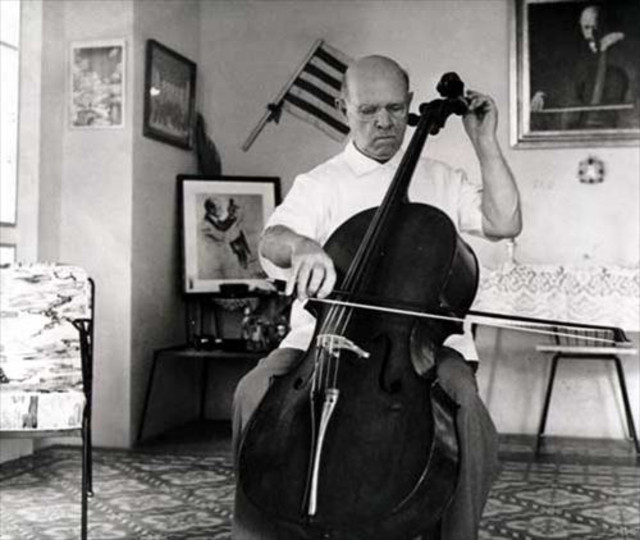
As the first modern cello virtuoso, Pablo Casals created a new appreciation of the instrument and its repertory when the concert stage was still considered the exclusive playground of the piano and violin. Casals also devoted his formidable musical skills to composition and conducting, leaving many insightful readings of the standard orchestral repertory to posterity via recordings. He is remembered today as much for his pacifism and regard for human life as for his musicianship (he once stated that "the life of a single child is worth more to me than all my music"). Casals came to his true instrument relatively late in life, having first developed some degree of skill on the piano, violin, and organ. Discovery of the cello at the age of 11 led to studies (from 1887 on) with J. Garcia at the Barcelona Municipal Music School. After a period of supporting himself playing in local cafés, Casals was granted a royal scholarship to the Madrid Conservatory in 1893, where he worked with Tomás Bretón, and later in Brussels in 1895. After a brief tenure as a cellist at the Folies-Marigny music hall in Paris, Casals returned to teach and perform in Barcelona, and joined the first of a series of notable chamber ensembles with which he would be associated: a piano trio with Belgian violinist Crickboom and well known pianist and composer Enrique Granados. In 1919 Casals founded the Orquestra Pau Casals in Barcelona. Although the project was quite successful, the outbreak of civil war in 1936 forced its dissolution. Casals, who spoke out vehemently against the Franco regime, was forced to seek refuge in the Catalan village of Prades. Following the Second World War, saddened by the lack of any definitive action against the Franco regime by major world powers, Casals elected to cease performing as an act of protest. Inspired by the Bach bicentenary celebrations of 1950 at the first annual Prades Festival, Casals came out of retirement to begin a new series of recordings and concerts. In 1956 he made a new home in Puerto Rico, where he founded the Puerto Rico Festival. Though nearing 85, he began a campaign for peace in 1962, traveling around the world to conduct performances of his oratorio El pessebre (The Manger). Casals continued to make occasional concert appearances until virtually the end of his life in 1973. Casals' impact on cello playing in the twentieth century cannot be overestimated. His radical approach to bow and finger technique produced a mechanical prowess far beyond any other cellist of the late nineteenth or early twentieth centuries. In addition, Casals was the first cellist to incorporate the kind of left-hand shifting techniques which had been employed for decades by violinists, thus allowing for far greater agility on the cello than had been previously thought possible. Always scornful of "flashy," superficial virtuosi, Casals strove tirelessly to develop and maintain the kind of intense musical concentration which he considered to be the true artist's responsibility. Casals' virtues as a composer are less unimpeachable; very little of his music was published during his life. Works such as his Hymn to the United Nations (1971), on text by W.H. Auden, and, of course, El pessebre (composed 1943-1960) did receive numerous performances, but his works received little more than cursory notice by the musical establishment. However, the steadfast devotion which so defined his performing persona is evident in such works as the Revérie for cello and piano (1896), or the much later Sonata for violin and piano, which he worked on sporadically from about 1945 to 1972.
First discovered Aug 23, 2026, 11:17 PM