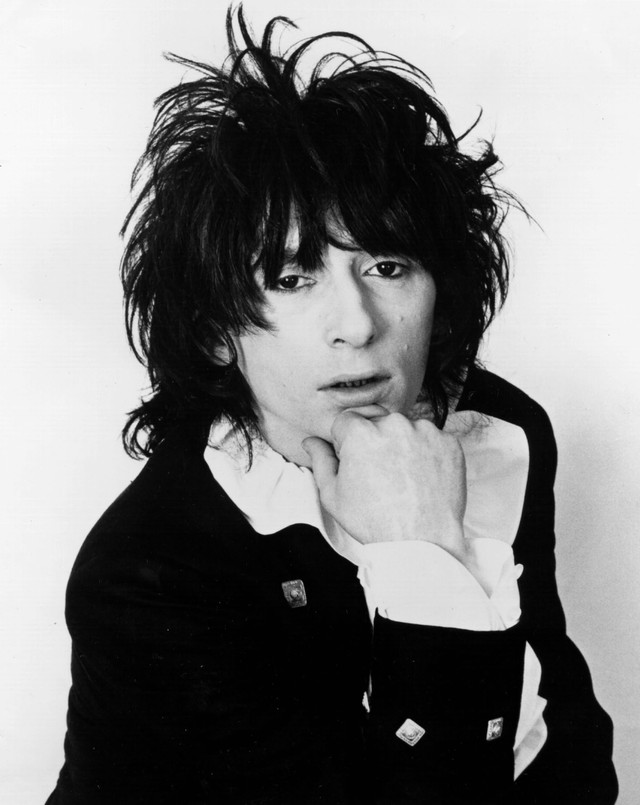
Johnny Thunders
Charts
Tracks
Playlists
SEO
Press Mentions
Overview
Included in high risk playlists
Monthly Listeners
Discography
Genres
Spotify has not assigned genres to this artist yet
Top Audiences
Top Listener Locations
 Los Angeles, US1,593
 London, GB1,385New York City, US1,191
 Melbourne, AU977Brooklyn, US893
Playlist Summary
Playlist Movement
No activity found
This artist's playlist additions and removals will appear here.
Biography & Metadata
Johnny Thunders was the first punk rock guitar hero, earning a cult following for his noisy but epic style a few years before the insouciant new music gained its name. Following in the footsteps of his idol and role model Keith Richards, Johnny Thunders (born John Anthony Genzale, Jr.) lived the ultimate rock & roll life, spending most of his days churning out tough, sloppy three-chord rock & roll and gaining nearly as strong a reputation for his decades-long struggle with addiction as for his music. Thunders made his greatest impact as a member of the New York Dolls, the proto-punk glam rockers of the early '70s. During the late '70s, he was a familiar figure on the New York punk scene, both with his band the Heartbreakers and as a solo artist. Thunders performed and recorded steadily until his death in 1991, turning out a series of records that inadvertently documented the struggles of his life and his art. Under the name Johnny Volume, Genzale began performing in high school with local combos Johnny & the Jaywalkers and the Reign (an unreleased Reign tune recorded in 1967 was released as a single after Thunders' death); after those bands ran their course, he joined Actress, which featured future Dolls Arthur Kane and Billy Murcia. Actress became the New York Dolls in 1971, with the addition of vocalist David Johansen, and Genzale renamed himself Johnny Thunders. After recording two acclaimed but commercially unsuccessful albums, the Dolls broke up. In 1975, Thunders and the group's drummer Jerry Nolan formed the Heartbreakers with former Television bassist Richard Hell and guitarist Walter Lure. Hell left the group shortly afterward to form the Voidoids and was replaced by Billy Rath. With Thunders leading the band, the Heartbreakers toured America and Britain, releasing one official album, L.A.M.F., in 1977. The group relocated to the U.K., where their popularity was significantly greater than it was in the U.S., particularly on the burgeoning punk scene. Thunders earned a reputation for powerful but inconsistent performances -- solid and rollicking one night, incoherent, sloppy, and drunken the next, sometimes veering between the two extremes in a single evening. After several months, the group returned to America, where they played a series of farewell gigs in New York. Thunders went solo in 1978, recording So Alone with various rock and punk celebrities, including the Sex Pistols' Steve Jones and Paul Cook, Steve Marriott (Small Faces, Humble Pie), Peter Perrett (Only Ones), Paul Gray (Eddie and the Hot Rods, the Damned), and Thin Lizzy's Phil Lynott. After its release, Thunders and Peter Perrett played in the short-lived band Living Dead, while in 1980 Thunders teamed up with MC5 guitarist Wayne Kramer in the band Gang Wars, another project that soon fizzled out. During the early '80s, Thunders re-formed the Heartbreakers for various tours and periodic "farewell" shows in New York City, with their stage work documented on a series of live albums, often of dubious legality. For most of the '80s, the only Johnny Thunders product available consisted of haphazard compilations of live tracks and demos. In 1984, Thunders rebounded with a surprisingly strong acoustic album, Hurt Me, followed in 1985 by Que Sera, Sera, a collection of new songs that showed he could still perform convincingly. Three years later, the guitarist recorded an album of rock and R&B covers with vocalist Patti Palladin, Copy Cats. And in 1991, German punk band Die Toten Hosen paid homage to Thunders by inviting him to play guitar on a cover of the Heartbreakers' "Born to Lose" on their album Learning English: Lesson One. After recording with Die Toten Hosen, Thunders settled in New Orleans, where he planned to cut an album with local jazz and R&B musicians. However, only a few days later, Thunders was found dead in his room at the St. Peter House on April 23, 1991. Thunders' passing was shrouded in rumor and uncertainty; while it was widely believed he overdosed on drugs, friends insisted the guitarist was weaning himself off heroin with methadone, while others believed he was the victim of sadistic burglars who ransacked his room after feeding him LSD, and still others reported Thunders was struggling with an untreated case of leukemia. Though Thunders' passing was strange and chaotic, it was curiously appropriate -- no other rock & roller ever lived as hard and traveled as individual a path as Johnny Thunders. ~ Stephen Thomas Erlewine, Rovi
First discovered Sep 23, 2026, 1:18 AM