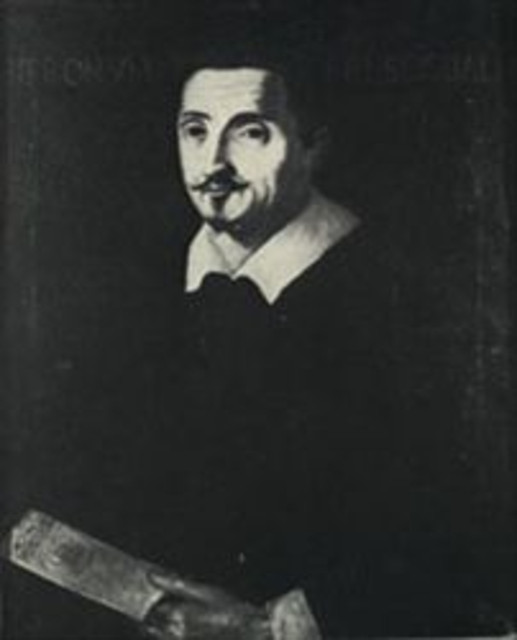
Girolamo Frescobaldi
Charts
Tracks
Playlists
SEO
Press Mentions
Overview
Not included in any known risky playlists
Monthly Listeners
Discography
Top Audiences
Top Listener Locations
 Madrid, ES603
 Mexico City, MX554
 London, GB400
 Paris, FR354
 Amsterdam, NL323
Playlist Summary
Playlist Movement
No activity found
This artist's playlist additions and removals will appear here.
Biography & Metadata
Girolamo Frescobaldi was a major composer from the late Renaissance and early Baroque periods whose keyboard works rank among the most important of his time. His sacred and secular vocal music is generally assessed to be less important but still significant. Frescobaldi appears to have learned much of his deft contrapuntal skill and harmonic boldness from his teacher Luzzaschi. The 12 Fantasie (1608) are notable for their brilliantly wrought counterpoint, but also for their somewhat arid intellectual character. The two books of Toccate, from 1615 and 1627, are both innovative, with the latter set showing greater structural complexity. Frescobaldi was born in Ferrara probably in mid-September 1583. His first teacher was likely his father, believed to be an organist. Girolamo became something of a child prodigy on the organ and was taken on as a pupil by court organist Luzzasco Luzzaschi, who was also a respected composer. At 14, Frescobaldi became organist at the Academia della Morte in Ferrara. With a prodigious talent and an apparently strong desire to further his career, he decided to travel to Rome in about 1599. Not much is known about his early years there. From January till June of 1607, he served as organist at Santa Maria in Trastevere. He might have continued in the position but for an offer from his friend and arts patron, Guido Bentivoglio, Archbishop of Rhodes. Bentivoglio departed Rome for Flanders on June 11, 1607, with Frescobaldi accompanying him as part of his entourage, intending to enter his service as a musician with duties not entirely clear. In 1608 the young composer's first works were published, a collection of madrigals and three canzones, which appeared in Alessandro Raverji's publication Canzoni. Frescobaldi stayed in Brussels for less than a year, returning to Rome to assume the post of organist at the Cappella Giulia at St. Peter's in Rome, thanks to the efforts of the influential Bentivoglio family. The organist's position was not a high-paying one, but finances were hardly a problem now: with his appointment to St. Peter's came service for Enzo Bentivoglio, ambassador to Rome from Ferrara. That position involved teaching the musicians in the ambassador's musical group or concertino. In about 1612, Frescobaldi began employment for the wealthy Cardinal Aldobrandini, who paid him nearly twice the salary he earned from his organist post at St. Peter's. On February 18, 1613, he married Orsola del Pino, who had already given birth to his son and was pregnant with a second child. With the publication in 1615 of ten ricercars and five canzones, both for keyboard, Frescobaldi's growing prominence clearly placed him in the forefront of Italian musicians. For the next 13 years, the composer would experience his most productive period, turning out collections of ricercars, canzones, and other works. In 1624, his 12 Capriccios for keyboard appeared, and three years later, volume two of his Toccatas. On November 28, 1628, the composer departed to become court organist in Florence, having been granted a leave from St. Peter's. Not much is known about his six-year stint in Florence, though he produced two volumes of arias and other vocal works there, titled Arie musicali. The composer returned to his St. Peter's post in April 1634. Frescobaldi's keyboard collection, Canzoni da sonare, was published in late that same year. Other important publications would come now as well, including the 12 Toccate (two volumes) of 1637, which were reissues of the earlier ones. That same year, he also began teaching Vienna court organist Johann Jacob Froberger, who would study with him until 1641. Frescobaldi died on March 1, 1643. ~ Robert Cummings, Rovi
First discovered Aug 18, 2026, 1:56 PM