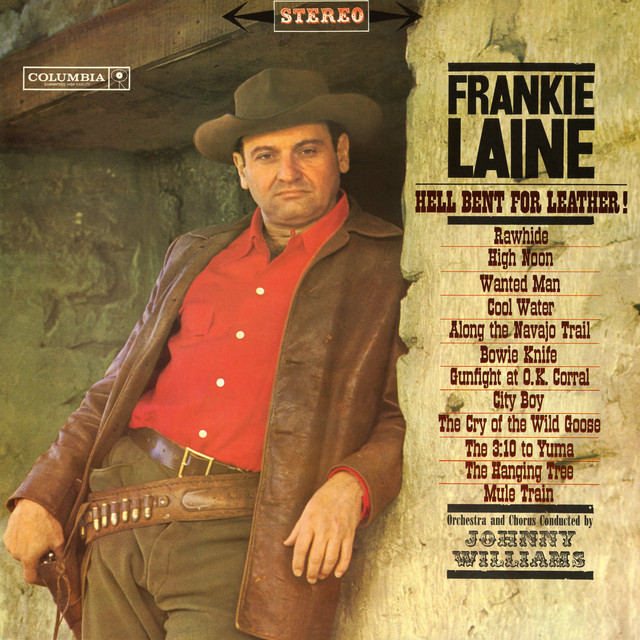
Frankie Laine
Charts
Tracks
Playlists
SEO
Press Mentions
Overview
Not included in any known risky playlists
Monthly Listeners
Discography
Top Audiences
Top Listener Locations
 London, GB3,803
 Sydney, AU3,413Melbourne, AU3,185Brisbane, AU2,757
 Chicago, US1,949
Playlist Summary
Playlist Movement
No activity found
This artist's playlist additions and removals will appear here.
Biography & Metadata
Frankie Laine was one of the most popular vocalists of the 1950s, swinging jazz standards as well as half a dozen Western movie themes of the time with his full-bodied baritone. Laine's popularity was even more dominating across the pond in the U.K., where he set two chart records in 1953: his version of "I Believe" stayed at number one in the U.K. for an incredible 18 weeks, and his two subsequent chart-toppers that year ("Hey Joe," "Answer Me") helped set a record by putting Laine at number one for 27 weeks during the year. Born in Chicago in 1913, Laine sang in the local church choir and first performed professionally at the age of 15. He moved to nightclubs by his later high-school years and began traveling around the country, performing as a singing waiter and dance instructor in addition to menial labor such as car sales and machinist work. Laine moved up a rung in 1937, when he replaced Perry Como in a regional big band led by Freddy Carlone. Laine was back on his own by the mid-'40s, but a stirring rendition of Hoagy Carmichael's "Rockin' Chair" performed one night when Carmichael was himself in the audience proved to be the young singer's break. Carmichael found him a job at Hollywood's Vine Street Club and funded Laine's first recording session; his instincts proved to be spot-on, since one of the tracks, "We'll Be Together," became quite popular after Laine signed with Mercury Records in 1945. "That's My Desire" hit number four in the U.S. two years later, and Laine re-entered the Top Ten in 1948 with "Shine." He hit the big time the following year, with two huge number one hits, "That Lucky Old Sun" and "Mule Train." Another chart-topper, 1950's "The Cry of the Wild Goose," was his last for Mercury, and he signed with Columbia just one year later. Laine's Columbia career saw him move toward husky country & western pop with arrangements and orchestra conduction by Mitch Miller, the vocal pop impresario known for producing much of the more sentimental pop music of the 1950s (and recording it as well, in a series of Sing-Along with Mitch Miller LPs). Even though Laine's debut Columbia single, "Jezebel"/"Rose, Rose, I Love You," was a double-sided Top Five hit, he never again reached number one in America, settling for consistent Top Ten placings during the early '50s, with "Hey, Good Lookin'," "Jealousy (Jalousie)," "High Noon," "I Believe," and "Tell Me a Story." Laine proved to be even more popular in Great Britain and Europe than America during this time, and after his last American Top Ten hit ("Love Is a Golden Ring" in 1957), he turned to lavish cabaret tours that crisscrossed the world and found him turning to increasingly inspirational and religious material. He retired to his home in California during the mid-'80s. Laine passed away from heart failure on February 6, 2007. ~ John Bush, Rovi
First discovered Sep 8, 2026, 10:49 PM