Francisco Tárrega
Charts
Tracks
Playlists
SEO
Press Mentions
Overview
Included in high risk playlists
Monthly Listeners
Discography
Genres
Spotify has not assigned genres to this artist yet
Top Audiences
Top Listener Locations
 Madrid, ES4,529
 Mexico City, MX4,332
 London, GB4,238
 São Paulo, BR3,513
 Sydney, AU3,208
Playlist Summary
Playlist Movement
No activity found
This artist's playlist additions and removals will appear here.
Biography & Metadata
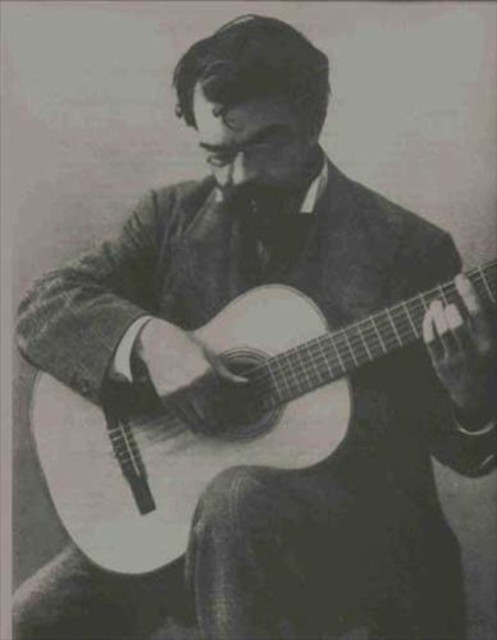
Francisco Tárrega was an important Spanish composer whose music and style of guitar playing became strongly influential in the twentieth century. He was central to reviving the guitar as a solo instrument in recital and concerts. Among his most popular compositions are Recuerdos de la Alhambra and Danza mora. He wrote nearly 80 original works for the guitar and over 100 transcriptions, mostly of piano pieces by Chopin, Beethoven, and others. Francisco Tárrega was born on November 21, 1852, in Villareal, Castellon, Spain. In his early childhood, Tárrega fell into an irrigation canal and injured his eyes. He was taught his first lessons on guitar by Eugeni Ruiz, a blind musician. In 1862, concert guitarist Julian Arcas, on tour in Castellon, heard young Francisco play and advised Tárrega's father to allow Francisco to come to Barcelona for study with him. Tárrega's father agreed, but insisted that he take piano lessons as well. His father was well aware that the guitar, as a solo vehicle, was in decline, coming increasingly to be viewed as an instrument to accompany singers, while the piano was all the rage throughout Europe. By his early teens, Tárrega had become proficient on both instruments. For a time, he played with other musicians at local engagements to earn money, but eventually he returned home. In 1874 he enrolled at the Madrid Conservatory where he would study composition under Arrieta. He had brought along with him a recently purchased guitar, made in Seville by Antonio Torres. Its superior sonic qualities inspired him both in his playing and in his view of the instrument's compositional potential. When Arrieta heard his student Tárrega in a guitar concert, he convinced him to focus on guitar and abandon ideas of a career involving the piano. In about 1876, Tárrega began teaching and giving regular guitar concerts. He typically received much acclaim for his playing and began traveling to other areas of Spain to perform. By this time he was composing his first works for guitar. In 1880, he met his future wife, Maria Rizo, when he was giving a concert in Novelda. That same year he went on tour to Lyon, Paris, and London, now playing his own works in addition to those of other composers. In 1881, he and Maria were married in Novelda. He soon began transcribing piano works of Beethoven, Chopin, Mendelssohn, and others to enlarge his guitar repertory, and, no doubt, to make use of his considerable knowledge of keyboard music. Tárrega and his wife moved to Madrid, but after the death of an infant daughter, Maria Josefa, they settled permanently in Barcelona in 1885. On a concert tour in Valencia shortly afterward, Tárrega met a wealthy widow, Conxa Martinez, who became a valuable patron to him. She allowed him and his family use of a house in Barcelona, where he would write the bulk of his most popular works, including Recuerdos de la Alhambra. From the latter 1880s up to 1903, Tárrega continued composing, but limited his concerts to Spain. In about 1902, he cut his fingernails and created a sound that would become typical of those guitarists associated with his school. The following year he launched a tour of Italy, giving highly successful concerts in Rome, Naples, and Milan. In January 1906, he was afflicted with paralysis on his right side, and though he would eventually return to the concert stage, he never completely recovered. He finished his last work, Oremus, on December 2, 1909. He died 13 days later.
First discovered Aug 19, 2026, 5:33 AM