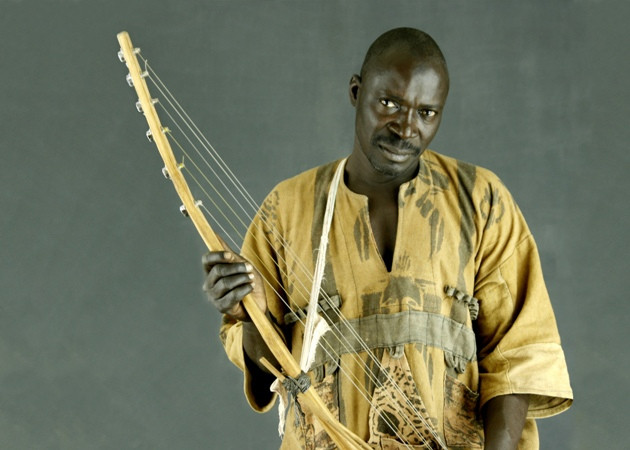
Issa Bagayogo
Charts
Tracks
Playlists
SEO
Press Mentions
Overview
Not included in any known risky playlists
Monthly Listeners
Discography
Genres
Spotify has not assigned genres to this artist yet
Top Audiences
Top Listener Locations
 London, GB1,525
 Berlin, DE645
 Amsterdam, NL591
 Sydney, AU539
 New York City, US508
Playlist Summary
Playlist Movement
No activity found
This artist's playlist additions and removals will appear here.
Biography & Metadata
Given the circumstances of his birth and upbringing, Issa Bagayogo's accomplishments as a groundbreaking artist fusing traditional and electronic music might seem unlikely. Born in 1961 to a farming family in Korin, a poor village 30 miles from the nearest town in southern Mali, his fate seemed to be to work the farm his father worked with his four wives and 14 other children. But Bagayogo was drawn to music, first playing the daro, a bell that keeps farm workers laboring. From there, at age 12, he took up the six-string young man's harp, or kamele n'goni, a common instrument throughout the Wassalou area of the country. He started singing and soon was making a name for himself locally. At the age of 30, he decided to try his hand in the Malian capital, Bamako, where he met a couple of Frenchmen who had just opened a studio and needed a kamele n'goni player. The end result was his first, very traditionally oriented cassette (cassette being the ubiquitous music medium in African and much of the world). It didn't make any money, but it was his. After three months, Bagayogo returned home, but came back to Bamako two years later to make his second cassette, which still brought no success. This time, however, he remained in Bamako, becoming an apprentice bus driver. Depressed at his failure as a musician, he began drinking and taking pills; his wife left and it seemed as if his life had bottomed out. Eventually, however, he decided to turn his life around and began playing and singing again. He returned to the studio, where he met French engineer Yves Wernert and Foamed Koné, who'd been a guitarist in Ali Farka Touré's band. What they wanted to attempt was something radically different for African music, mixing traditional music with beats and samples. At first Bagayogo was unsure, if only because it was so unlike anything he'd done. He'd never worked with drum machines before and the process proved complex. In late 1998, though, Sya was released by Six Degrees Records, selling a phenomenal 15,000 copies and getting Bagayogo an award in 1999 as Malian song's Brightest New Hope and the nickname of Techno Issa, in addition enabling him to finally quit his job as an apprentice bus driver. In 2002, Timbuktu, the second album from the trio's collaboration, appeared, also on Six Degrees. Two more Bagayogo albums would be released by the label, Tassoumakan in 2004 and Mali Koura in 2008. Sadly, Issa Bagayogo died in October 2016 after a lengthy illness. He was 55 years old. ~ Chris Nickson, Rovi
First discovered Aug 23, 2026, 7:03 PM