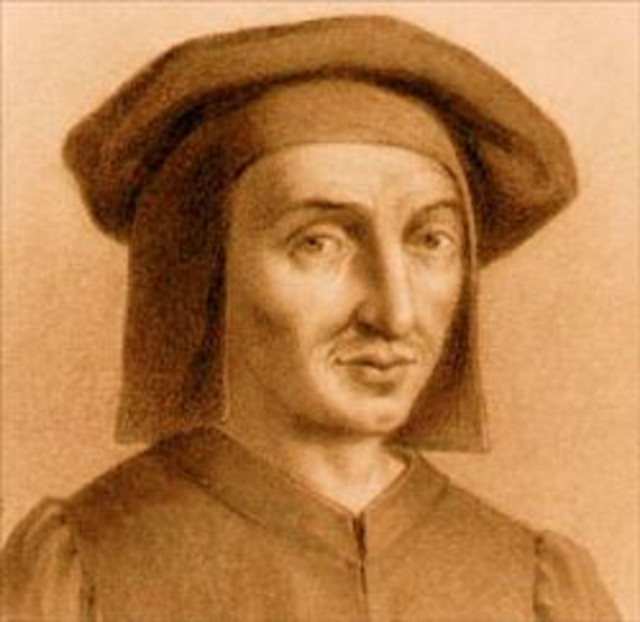
Josquin des Prez
Charts
Tracks
Playlists
SEO
Press Mentions
Overview
Not included in any known risky playlists
Monthly Listeners
Discography
Genres
Spotify has not assigned genres to this artist yet
Top Audiences
Top Listener Locations
 London, GB1,144
 Madrid, ES745
 Amsterdam, NL604
 Mexico City, MX565
 Berlin, DE526
Playlist Summary
Playlist Movement
No activity found
This artist's playlist additions and removals will appear here.
Biography & Metadata
"Master of the notes," Martin Luther called him. To contemporary prelates, Josquin was an adornment worthy of a world-class court; to music publishers, his was the name that assured sales; and other composers claimed his tutelage to improve their own image. Josquin's music is regarded as one of the great treasures of Western culture. Furthermore, in his compositions, music historians have seen a crucial link in the development of the Renaissance "Central Musical Language." And yet, a reliable biography of this pivotal figure has remained maddeningly elusive. As of the year 2000, the edifice of the textbook biography was overthrown by new archival discoveries. At least three prominent musicians of his time were called "Josquin"; the presence of another in Milan has bewildered "our" Josquin's biographers by suggesting a 1440 birth date and a surprisingly mediocre early career in Italy. (Similar confusion would ensue from the discovery of two Elizabethan playwrights named William Shakespeare.) The Josquin who would cast his mythic shadow across the centuries was born in the 1450s, in northern France or Hainaut (present-day Belgium), son of Gossard Lebloitte. Despite strong family ties and, later, an inheritance in Condé, Josquin's path took him south to Aix-en-Provence, where he joined King René d'Anjou's court as a singer. The young musician began his career as early as 1475 in a prosperous (and Italophile) court establishment, surrounded by a supportive courtiers' "network." After René's death in 1480, most of his singers were retained by his nephew, King Louis XI of France; Josquin may have served Louis from 1480/81 to 1483. This position may have provided an opportunity for Josquin to meet to the King's renowned Premier chapellain, Johannes Ockeghem. By 1484, Josquin had become a commensural familiar (personal servant, as well as singer) to Ascanio Sforza, brother to the Duke of Milan. Not only did this bring Josquin into the orbit of one of the most splendid courts of Quattrocento Italy, but Ascanio's elevation to the Cardinalate likely brought his familiar to Rome (August 1484 until 1487, returning to Milan in 1488-1489). Josquin's relationship to this generous and well-connected patron continued into the next century as attested by printed attributions of music to "Josquin d'Ascanio" in 1504 and 1509. His next musical appointment, however, was to the Papal Choir in Rome, from June of 1489 until at least 1495. Two new expectative benefices in Thérouanne and Cambrai, close to his homeland, were among his immediate compensations. His location around the turn of the century is currently unknown, though this period saw a surge in the dissemination of his music, in manuscripts from centers such as Rome, Milan, and Brussels/Mechlin, but also in Petrucci's revolutionary musical press in Venice. After a brief, but highly lucrative, tenure as Maestro di cappella for the Duke of Ferrara from 1503-1504, the aging Josquin-hero passed into semi-retirement back in Condé. The collegiate church of Notre-Dame in Condé accepted him as provost in May 1504, and he purchased a new house in August, remaining until his death in 1521. During this time, he was an ordained priest and maintained some level of activity as a composer; as late as 1520, he presented a volume of chansons to Holy Roman Emperor Charles V. Josquin's will bequeathed his home to the collegiate church, to endow his stipulated obituary services: Marian "Salve" services on Saturdays throughout the year and on Marian feast days, and the singing of his own Pater noster and Ave Maria in front of his house during all general liturgical processions. And with the profuse laments of his contemporaries, the creation of his legend began. ~ Timothy Dickey, Rovi
First discovered Aug 18, 2026, 2:44 PM