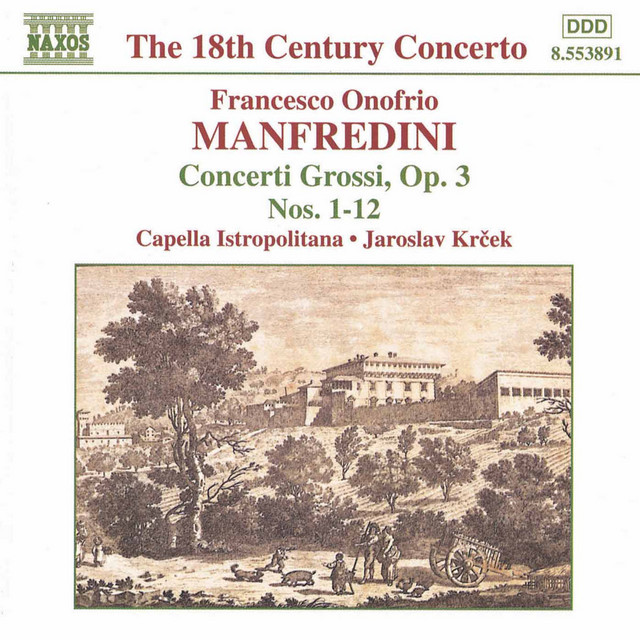
Francesco Onofrio Manfredini
Charts
Tracks
Playlists
Press Mentions
Google Rankings
Overview
Not included in any known risky playlists
Monthly Listeners
Discography
Top Audiences
Top Listener Locations
 Madrid, ES493
 Mexico City, MX456
 Amsterdam, NL417
 London, GB339
 Berlin, DE326
Playlist Summary
Playlist Movement
Event | Playlist | Botted? | Position | Track | Happened at | |
|---|---|---|---|---|---|---|
Biography & Metadata
Francesco Onofrio Manfredini was born during a particularly fertile period for the production of great composers. Born within 16 months of him were Rameau, Walther, Handel, Johann Sebastian Bach, and Domenico Scarlatti. Against the glare of these first-magnitude stars (and the not much older Telemann and Vivaldi), the lesser but noteworthy talent of Manfredini is easy to overlook. His father was a trombonist in the parish church of Pistoia. He was sent to Bologna as a teenager to study violin with Giuseppe Torelli and counterpoint with Perti. In 1700, the 16-year-old Manfredini went to Ferrara to take a job as first violinist in the Church of the Holy Spirit. In 1704, the orchestra of Bologna's church of San Petronio was reconstituted. Since its dissolution was the reason Manfredini had left Bologna in the first place, he returned and joined it, also becoming a member of the Accademia Filarmonica. He published a set of concerti in 1704. In 1707, as Manfredini was preparing to visit or move to Venice, a friend named Aldrovandini, with the intent of traveling to Venice with him, accidentally drowned on his way to joining Manfredini. It's not clear whether Manfredini went ahead with his planned trip, nor is much known about Manfredini's doings for the next 20 years. There is speculation that he joined the court of Prince Antoine I of Monaco. During these years, he published additional sets of incidental music, a group of 12 Sinfonie da chiesa, and 12 concerti. He also wrote an oratorio, Tommaso Moro. In 1724, he returned to Pistoia to become maestro di cappella of St. Philip's Cathedral there. Shortly afterwards, he published four oratorios, presumably all written in the years 1725-1728. He remained in that post until his death 35 years later. Manfredini was not a prolific composer, or if he was, an undue amount of his work has been lost, but there are 43 published instrumental works, nine oratorios (music lost), and a couple of unpublished works. Although he lacks a distinctive personal "sound," his instrumental music is attractive, with the group of six posthumous sonatas (London, 1764) being the best representation of his talents. Unfortunately for his reputation, he became something of a symbol for the mediocre, run-of-the-mill Baroque composer in the 1970s when musicologist H.C. Robbins Landon wrote an article, "A Pox on Manfredini," intended to decry the record companies' trend of recording the "complete music" of Baroque composers, no matter how unimportant. While Landon's main point was not ill-taken, he did unnecessarily disparage Manfredini's music.
First discovered Oct 24, 2026, 10:51 AM