Santiago De Murcia
Charts
Tracks
Playlists
Press Mentions
Google Rankings
Overview
Not included in any known risky playlists
Monthly Listeners
19,497 – 19,571
Discography
Top Audiences
Top Listener Locations
 Madrid, ES597
 Mexico City, MX450Barcelona, ES253
 London, GB233
 Paris, FR199
Playlist Summary
Playlist Movement
Event | Playlist | Botted? | Position | Track | Happened at | |
|---|---|---|---|---|---|---|
Biography & Metadata
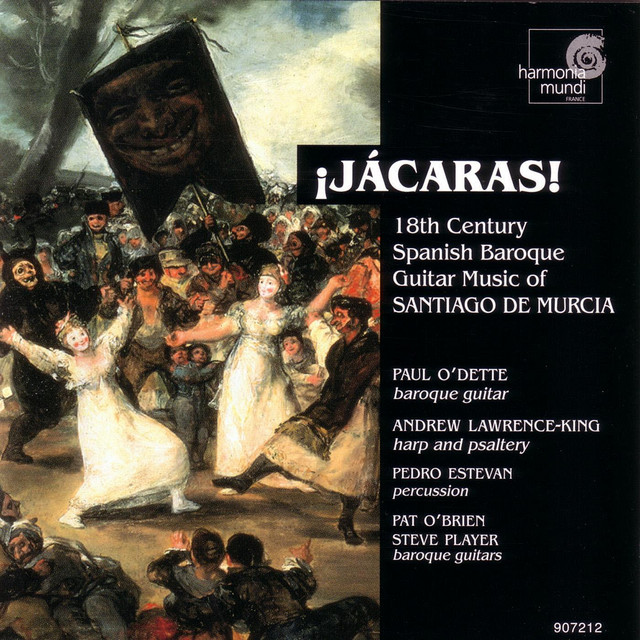
Santiago de Murcia was one of the leading Spanish composers of his day and among his country's finest guitarists and pedagogues, as well. His surviving works were all written for the five-course Baroque-style guitar, which has nine strings, one on the first course and two each on the remaining ones. Murcia was born around 1682, probably in Madrid. Little is known about his early years, though it is believed he had a brother, Antonio, who was a guitar-maker. Around the age of 10 Santiago likely began studying with master guitarist and teacher Francisco Guerau, who had connections to the highest royal circles in his directorship roles at the royal choir school and royal chapel in the 1690s. Murcia himself secured a post at the Spanish Court in the early 1700s as the Queen's guitar teacher. The aforementioned Antonio de Murcia also worked for the Queen (María Luisa Gabriela) as her guitar maker. Santiago de Murcia's treatise Resumen de acompañar la parte con la guitarra (completed before 1714) was dedicated to one of his patrons, Jácome Francisco Andriani, the Dutch ambassador at the Court. The book deals with many performance issues on guitar, but also contains a number of French dances. At the time Murcia wrote Resumen he was residing in Andriani's house and likely was well paid by him. Murcia had at least one other important supporter, Joseph Álvarez de Saavedra, notary to King Felipe V. He would become a factor in the composer's later years in Mexico. Murcia's works frequently appeared in the early eighteenth century, and some may have had origins in the theater as collaborations with other prominent composers of the day, like Pedro Lanini and Francisco de Castro. Murcia departed Spain in about 1718. He traveled first to Europe, possibly to France and Holland, then settled in Mexico, probably in an arrangement made by the Court since Álvarez de Saavedra had also moved there around the same time. Little is known about Murcia's life in Mexico, though he may have lived in Puebla, the city in which Saavedra died. Murcia produced at least two manuscripts during his Mexican years, one containing his famous guitar collection, Passacalles y obras, dedicated to Saavedra. It is a compilation of 14 passacaglias (each with numerous variations) and 11 large suites, each a collection of works in itself. Murcia probably died in Mexico around 1740.
First discovered Aug 18, 2026, 1:59 PM