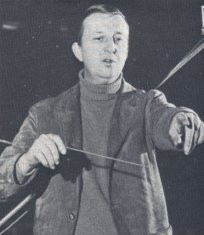
Jean-François Paillard
Charts
Tracks
Playlists
SEO
Press Mentions
Overview
Not included in any known risky playlists
Monthly Listeners
Discography
Genres
Spotify has not assigned genres to this artist yet
Top Audiences
Top Listener Locations
 Mexico City, MX18,782
 Madrid, ES12,274
 São Paulo, BR11,290
 Santiago, CL10,315
 London, GB8,296
Playlist Summary
Playlist Movement
No activity found
This artist's playlist additions and removals will appear here.
Biography & Metadata
Conductor and musicologist Jean-François Paillard was one of the most visible French exponents of Baroque music from the 1960s onward. Paillard earned a degree in mathematics from the Sorbonne, but he turned to music soon after. He attended the Paris Conservatory as a musicology student, where he won first prize in music history; he later studied conducting at the Salzburg Mozarteum with Igor Markevitch. He formed the Ensemble Jean-Marie Leclair in 1952, which was renamed the Jean-François Paillard Chamber Orchestra the following year. Comprised of a dozen string players and a harpsichord, the group paralleled such small-scale English ensembles as the Boyd Neel Orchestra in performing Baroque-era works -- especially those from France -- as well as contemporary works for string orchestra. As the public's interest in Baroque music rose, the orchestra's popularity grew and was aided by a series of international tours covering dozens of countries. The group's recordings on Erato -- which included the standard Baroque repertory such as Bach's Brandenburg Concertos and the Orchestral Suites, as well as pieces by Couperin and Rameau -- were initially easier to find in Europe. But when RCA Victor picked up the Erato catalog for U.S. distribution in the 1970s, Paillard's records were snapped up by American listeners. Lightning struck for Paillard late in the decade with his recording of the Canon in D by Johann Pachelbel. Paillard's ran nearly twice as long as most rival recordings, by virtue of its uniquely slow tempo and its finely delineated parts for the strings, both bowed and pizzicato. Paillard further benefited when Victor issued it on a full-priced LP and paired it with Fasch's Trumpet Concerto and grouped with various RCA artists on a budget-priced compilation LP called Go for Baroque. Sales of Go for Baroque moved faster than Beatles' albums were sold. Paillard's performances and recordings have also included works by Roussel and Debussy. He worked with such celebrated soloists as Maurice André and Jean-Pierre Rampal. Paillard won numerous Grand Prix du Disque awards in France and Prix Edison awards in Holland and his release of Rameau's Les Indes galantes remains a highly regarded recording. Later in his career, Paillard turned more to guest conducting orchestras around the world and his avid interest in the sciences.
First discovered Aug 21, 2026, 4:30 AM