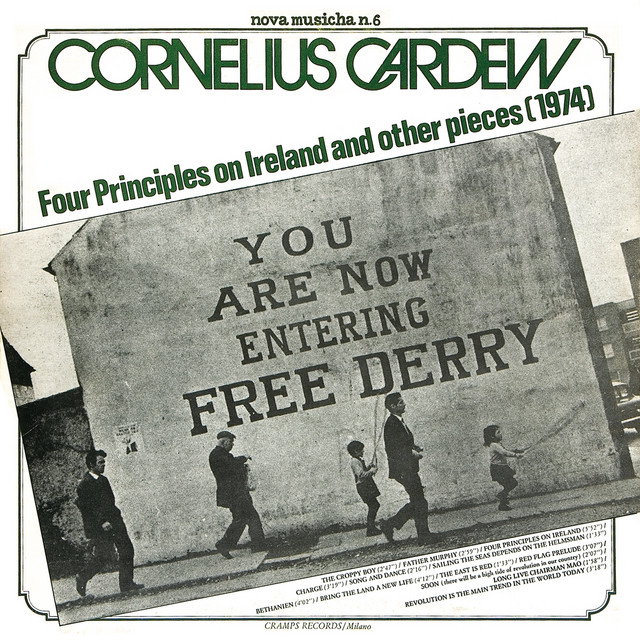
Cornelius Cardew
Charts
Tracks
Playlists
SEO
Press Mentions
Overview
Not included in any known risky playlists
Monthly Listeners
Discography
Genres
Spotify has not assigned genres to this artist yet
Top Audiences
Top Listener Locations
 London, GB29
 Berlin, DE15
 Melbourne, AU11
 New York City, US11
 Mexico City, MX10
Playlist Summary
Playlist Movement
No activity found
This artist's playlist additions and removals will appear here.
Biography & Metadata
Cornelius Cardew was the fundamental figure in the British avant-garde of the 1960s. Cardew grew up in Cornwall and at the age of 17 entered the Royal Academy of Music in London. Cardew developed an interest in electronic music, and in 1957 traveled to Germany to study in the Cologne-based electronic music studio of composer Gottfried Michael Koenig. Cardew then joined Karlheinz Stockhausen as his assistant. Cardew stayed with Stockhausen for three years, working on the latter's massive multi-orchestral work Carré. Cardew returned to England in 1961, supporting himself by working as a graphic artist and organizing concerts. He undertook a number of challenging scores with an emphasis on graphic notation and verbal instructions, such as the verbal-vocal The Great Learning (1961) for untrained chorus and orchestra and Volo Solo for piano (1964). In 1966 he joined the improvisational electronic group AMM, probably the first ensemble of its kind in Europe. In 1967 he completed his magnum opus, Treatise, consisting of 193 pages of music in graphic notation. In 1968 Cardew, Michael Parsons, and Howard Skempton formed the Scratch Orchestra, which improvised music from verbal instructions and other minimalist prompts. Cardew published a book based on their experiments entitled Scratch Music in 1971 that has become a standard reference work for experimental musicians ever since. As composer, Skempton recalled, "Cornelius was a visionary and his humane, prophetic powers affected everyone around him." Around 1970 Cardew became increasingly involved in leftist political thought inspired by the works of Mao Zedong. He came to regard his own work in the avant-garde as elitist and rejected it, publishing a book in 1974 entitled Stockhausen Serves Imperialism. Many of Cardew's colleagues thought he'd lost his mind, and regarded coolly the new works that Cardew composed, written in a post-Romantic, populist, and somewhat monotonous tonal idiom. In hindsight it is clear that in this phase of Cardew's work he was helping open the door to the "New Tonality," a style enthusiastically endorsed, though individually modified by the English composers who followed him -- Skempton, Parsons, Michael Nyman, Gavin Bryars, Brian Eno, Christopher Hobbs, and others. Cardew did not live to witness the success of this final contribution to English post-modernism; estranged from most of his colleagues and under scrutiny owing to his political convictions, Cardew was crossing a street in London when he was killed in a hit-and-run accident at age 45.
First discovered Aug 26, 2026, 2:53 PM