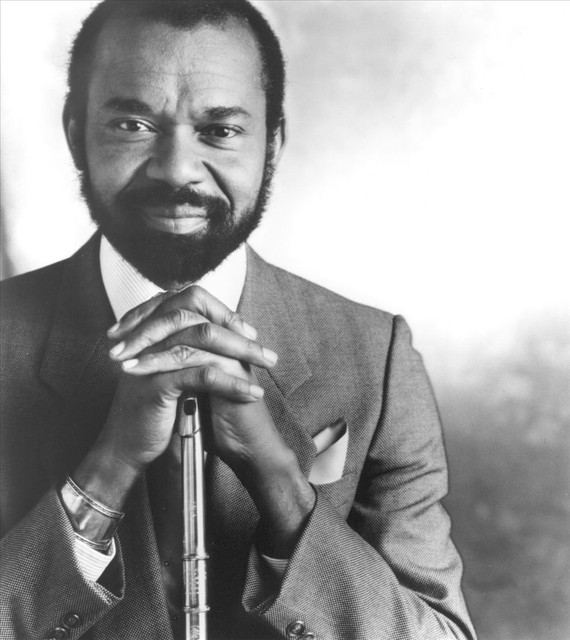
Hubert Laws
Charts
Tracks
Playlists
SEO
Press Mentions
Overview
Not included in any known risky playlists
Monthly Listeners
Discography
Genres
Spotify has not assigned genres to this artist yet
Top Audiences
Top Listener Locations
 São Paulo, BR5,423Rio de Janeiro, BR3,013Belo Horizonte, BR2,803Brasília, BR1,283Salvador, BR1,069
Playlist Summary
Playlist Movement
No activity found
This artist's playlist additions and removals will appear here.
Biography & Metadata
Hubert Laws is an award-winning and Grammy-nominated flutist and saxophonist whose musical interests run the gamut from classical, jazz, and R&B to pop and Broadway. Laws grew up in Houston, in a musical household. His mother was a singer, his grandfather a musician, and almost all of his siblings -- most notably brother Ronnie Laws -- pursued professional careers in music. Hubert studied piano first, then mellophone, and eventually flute in high school. Between 1954 and 1960 (when he won a scholarship to Julliard), he was a member of the early Jazz Crusaders. During his time at Julliard, he studied with Julius Baker and played with the New York Metropolitan Opera Orchestra (as a bonded member) and the New York Philharmonic Orchestra under Leonard Bernstein. He was also moonlighting in jazz, working with personas as diverse as Mongo Santamaria, Benny Golson, Jim Hall, James Moody, and Clark Terry, among many others. He signed to Atlantic and his debut album, The Laws of Jazz, was released in 1964. Two other releases appeared in 1966 (Flute By-Laws) and 1969 (Laws Cause). He signed to Creed Taylor's CTI label and issued the soul-jazz date Crying Song; it was not only a hit, but elevated his public profile past Herbie Mann's (Mann was jazz's most high-profile flutist for more than a decade). In 1970, Laws issued Afro-Classic, which showcased a jazz version of James Taylor's "Fire and Rain" with jazz-filtered classical pieces by Bach and Mozart, as well as a film theme by Francis Lai, which offered fans a completely different look at the artist. 1972's Rite of Spring was comprised exclusively of classical material played by sidemen who included Airto, Bob James, Ron Carter, and Jack DeJohnette. It is regarded as a jazz classic. The recording topped many critics' lists for the year despite the fact that Laws' issued two more full-lengths that year, Wild Flower for Atlantic (his final release for the label) and the provocative Morning Star for CTI, which placed Laws in a funky soul-jazz setting with a large, lush group of musicians and full string and horn sections conducted and arranged by Don Sebesky. Laws remained with CTI through 1978, releasing In the Beginning and The Chicago Theme, among others. He was also a featured guest on dates by George Benson and Grant Green during the era. Laws embraced jazz, funk, and disco when he signed to Columbia for 1979's In the Beginning, which he composed, arranged, and conducted. While more staid jazz fans took issue with his direction, jazz radio and club DJs embraced it. 1980's funky Family featured his sister Debra on one cut, surrounded by a crew that included Chick Corea, Bobby Lyle, Nathan East, and Leon "Ndugu" Chancler. That same year, he and Earl Klugh co-composed and recorded the music and soundtrack for How to Beat the High Cost of Living. (Laws has also contributed to other film scores. Some of his credits include The Wiz, The Color Purple, and A Hero Ain’t Nothing But a Sandwich.) With Jim Hall and Chet Baker, he recorded the trio date Studio Trieste for CTI. He wed funk and classical on 1984's Make It Last, and the following year he recorded two classical works, Harold Alfred Blanchard's New Earth Sonata and George Telemann's Suite in A Minor (Overture/Air Italien/Rejouissance) --the latter was conducted by Quincy Jones. It was his last date for Columbia. After 1987's Very Well, an all-star sextet session with Carter, Pendarvis, Eric Gale, Buddy Williams, and Victor See Yuen, Laws took a break from recording for seven years, choosing to participate in live classical and musical theater endeavors as well as an abundance of high level session work. He returned to recording the early '90s and issued My Time Will Come in 1993 and Storm Then the Calm the following year for MusicMasters. In 1998, he released the critically acclaimed Hubert Laws Remembers the Unforgettable Nat King Cole. Other activities included annual performances at Carnegie Hall, sold-out performances in the Hollywood Bowl with flutist Jean-Pierre Rampal, and performances with the Detroit Symphony. In 2002, Laws took on Brazilian and Latin jazz on Baila Cinderella, and two years later he released the charting Moondance for Savoy. To date, he's won Best Jazz Flutist 24 times in the Downbeat Reader's Poll and won the critic’s poll seven -- the latter were all in the 21st century. 2015 yielded Symphonic Arrangement: Suite for Flute & Jazz Piano Trio with Steve Barta and Jeffrey Biegel. ~ Thom Jurek, Rovi
First discovered Aug 23, 2026, 8:49 PM