Ali Akbar Khan
Charts
Tracks
Playlists
SEO
Press Mentions
Overview
Not included in any known risky playlists
Monthly Listeners
Discography
Genres
Spotify has not assigned genres to this artist yet
Top Audiences
Top Listener Locations
 Bengaluru, IN1,396Mumbai, IN1,196Pune, IN1,038New Delhi, IN956Kolkata, IN951
Playlist Summary
Playlist Movement
No activity found
This artist's playlist additions and removals will appear here.
Biography & Metadata
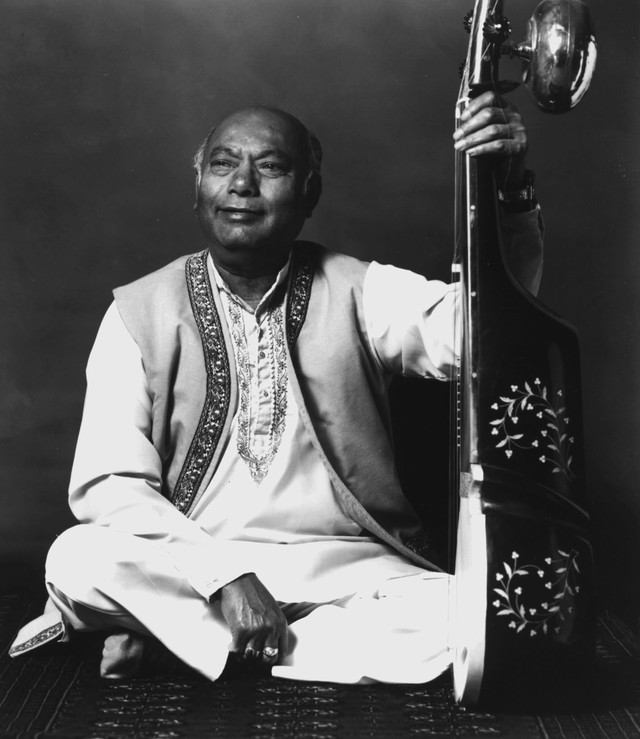
The son of influential Hindustani musician Allaudin Khan, Ali Akbar Khan was one of the Eastern world's greatest musicians. A master of the sarod, a 25-stringed, lute-like, Indian instrument, Khan brought the Northern Indian classical music to the international stage. A five-time Grammy nominee, Khan was called, by Yehudi Menuhin, "an absolute genius, the greatest musician in the world." Tracing his ancestral roots to Mian Tansen, a 16th century musician in the court of Emperor Akbar, Khan began studying music at the age of three. Initially studying vocal music with his father, he studied drums with his uncle, Fakir Aftabuddin. Although he tried playing a wide variety of instruments, he felt most comfortable on the sarod. Training and practicing 18 hours a day, he slowly mastered the instrument. In 1936, he made his public debut during a concert in Allahabad. In the early '40s, Khan became a court musician for the Maharaja of Judhpur. He soon acquired the title "Ustad" (master musician). In 1955, Khan accepted an invitation from Menuhin to perform in the United States. In addition to performing at the Museum of Modern Art in New York, he recorded the first Western album of Indian classical music and became the first Indian music on an American television when he appeared on Alistair Cooke's Omnibus. In 1971, Khan performed with his brother-in-law, Ravi Shankar, during George Harrison's Concert for Bangladesh at Madison Square Garden. Khan received numerous awards including the President of India Award in 1963, the Padma Vibhusan in 1988, the Bill Graham Lifetime Achievement award in 1993, and the Asian Paints Shiromani Hall of Fame Award in 1997. He received the Kalidas Sanman from the Madya Pradesh Academy of Music And Fine Arts and became the first Indian musician to be awarded a MacArthur Foundation "Genius Grant" in 1991. Khan received a National Heritage Fellowship from the National Endowment of the Arts in 1997. In 1956, Khan founded the Ali Akbar Khan College of Music in Calcutta. Teaching in the United States since 1965, he opened the Ali Akbar College of Music in Berkeley, CA, two years later. (In 1968, the school moved to a new site in San Rafael.) Khan taught six classes a week for nine months a year. In the early '90s, the school opened branches in Fremont, CA, and Basel, Switzerland. The lengthy list of films featuring Khan's music includes Chetan Anand's Aandhiyan, Satyajit Ray's Devi, and Bernardo Bertolucci's Little Buddha. He received a Best Musician of the Year award for his soundtrack for the film Khudita Pashan. ~ Craig Harris, Rovi
First discovered Aug 24, 2026, 1:02 AM