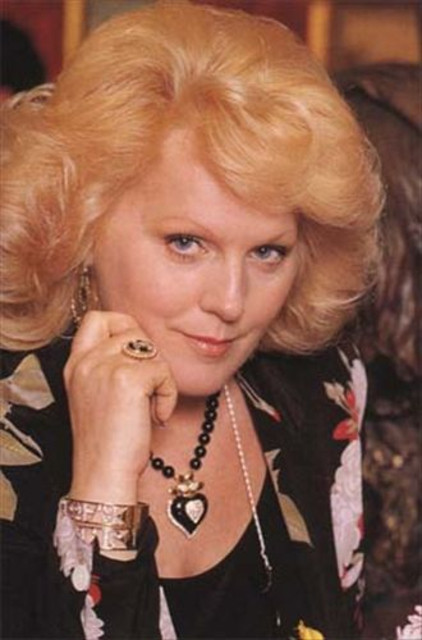
Katia Ricciarelli
Charts
Tracks
Playlists
Press Mentions
Google Rankings
Overview
Not included in any known risky playlists
Monthly Listeners
Series
- Monthly Listeners
- Listeners from Playlists
- Change
Discography
Genres
Spotify has not assigned genres to this artist yet
Top Audiences
Top Listener Locations
 London, GB900
 New York City, US668
 Madrid, ES534
 Berlin, DE456
 Mexico City, MX425
Playlist Summary
Playlist Movement
Biography & Metadata
Katia Ricciarelli, in her prime, possessed a radiant lyric soprano voice with an individually sweet timbre, and a lovely stage presence that complemented her voice. However, like all too many singers, she became a textbook example of what happens when a voice is pushed beyond its limits. During her best years, she was one of the most touching Giuliettas (I Capuleti e i Montecchi), Desdemonas, and Anna Bolenas on the operatic stage, and had a special affinity for Rossini's music, enjoying great success in such roles as Bianca (Bianca e Falliero), Elena (La donna del lago), and Amenaide (Tancredi). She came from a very poor family and after graduating from school, worked to afford the time and money to study at the Benedetto Marcello Conservatory in Venice, where she worked primarily with Iris Adami Corradetti, herself a noted lyric soprano. Upon graduation, she made her operatic debut as Mimì in Puccini's La bohème, in Mantua, Italy. Her appearance in Cherubini's Anacréon the next year in Siena created a small sensation, followed by a greater one when she won the Parma Verdi competition, followed in 1971 by her winning the Voce Verdiane competition. Largely on the strengths of these triumphs, in 1972, she debuted at the Lyric Opera of Chicago as Lucrezia in Verdi's I due Foscari, and at the Rome Opera as Verdi's Giovanna d'Arco. In 1974, she made her Covent Garden debut as Mimì. Her Met debut was also in La bohème in 1975, and her La Scala debut was in 1976 as Suor Angelica in Puccini's Il trittico. Like many singers, her voice became larger as she matured, allowing her to take on such roles as Verdi's Desdemona and Luisa Miller. However, over-encouraged by this, and also guided by Karajan, who often pitted essentially lyric voices against heavy roles, in the early 1980s, she began to sing roles that were considerably too dramatic, such as Tosca, Aida, and even Turandot (though only in the recording studio.) By the 1990s, while it had not lost all of its luster, her voice was no longer as limpid as it had been, both the top and middle were wobbly, and her pitch had become frequently imprecise. Some of the theaters where she had scored her major triumphs, such as La Scala, received her subsequent performances very badly. Among her recordings, a collection of arias made in 1979 and 1980 (Ermitage) catches her still in fine voice, although some strain does show in the more dramatic roles. In complete operas, her recording of La donna del lago (Sony) is excellent. She also appeared as Desdemona in the 1986 film of Otello, directed by Franco Zeffirelli.
First discovered Aug 21, 2026, 2:43 AM