Paul Creston
Charts
Tracks
Playlists
SEO
Press Mentions
Overview
Not included in any known risky playlists
Monthly Listeners
Discography
Genres
Spotify has not assigned genres to this artist yet
Top Audiences
Top Listener Locations
 Dallas, US76Houston, US67Chicago, US55Los Angeles, US40Atlanta, US40
Playlist Summary
Playlist Movement
No activity found
This artist's playlist additions and removals will appear here.
Biography & Metadata
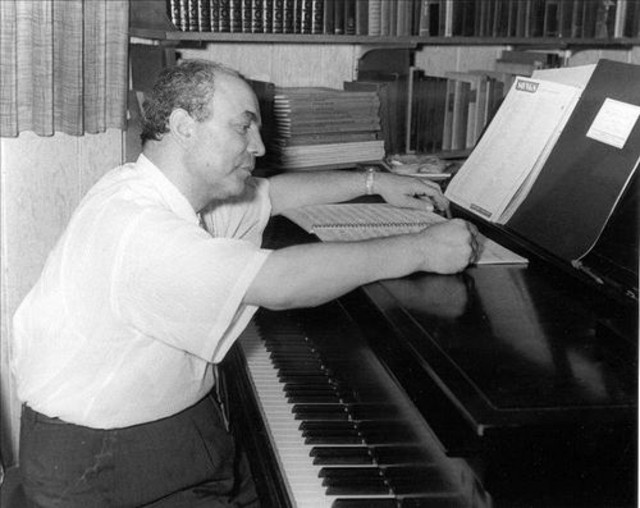
As a composer, Paul Creston was about as self-made as he could be. Born Giuseppe Guttoveggio in New York City in 1906, Creston chose his professional surname from a high school play he'd been in, adopting "Paul" simply because it appealed to him. The son of poor Italian immigrants -- his father was a housepainter -- Creston was forced to leave high school after two years to work at a variety of jobs. Still, he educated himself in his free hours, practicing on a $10 piano and studying the scores of the masters: Beethoven, Mozart, Brahms, Chopin, Debussy, Ravel, Stravinsky, and, above all, Johann Sebastian Bach. To fuel his nocturnal marathons, Creston bypassed coffee drinking altogether and took to smoking ground coffee beans in his pipe. Recognition came late to Creston, who devoted his energies to composition only from 1932; but when the accolades and honors did come, they were many and impressive. Early performances of his music by Henry Cowell, a similarly accomplished autodidact, led to a 1938 Guggenheim fellowship. In 1941, Creston's Symphony No. 1 received the annual award from the New York Music Critics' Circle. To his accelerating musical activities Creston added teaching duties, first at Swarthmore, and later at the New York College of Music (1963-1967) and Central Washington State College (1968-1975). His music was championed by a number of important conductors, including Toscanini, Ormandy, and Stokowski, but few were as committed to Creston's music as Howard Mitchell, longtime conductor of the National Symphony Orchestra of Washington, D.C. Creston composed in a variety of forms; his catalogue includes six symphonies, 15 concerti (including some for neglected instruments like marimba and saxophone), and miscellaneous orchestral, chamber, choral, and vocal works. Creston demonstrated a particular affinity for the poetry of Walt Whitman, which inspired five major scores between 1934 and 1972. Though Creston's bold use of counterpoint often results in striking dissonance, he considered serialism a terrible mistake that would eventually be corrected. Accordingly, Creston's music is always distinctly tonal in the modern American idiom and possessed of a strong rhythmic sense. Rhythm is so central to Creston's aesthetic, in fact, that in addition to authoring two texts on rhythmic matters -- Principles of Rhythm (1964) and Rational Metric Notation (1979) -- the composer wrote a ten-volume series of 123 instructional piano works collectively titled Rhythmicon (1977). From his earliest years as a composer, Creston maintained a post as organist of St. Malachy's Church in New York City (1934-1967). There is a distinct religious sensibility to much of his music that is clearly evident in such works as the Symphony No. 3 ("Three Mysteries"; 1950) and the orchestral meditation Corinthians: XIII, Op. 82 (1963). After retiring from his academic career, Creston moved to San Diego, where he died on August 24, 1985.
First discovered Aug 22, 2026, 12:05 PM