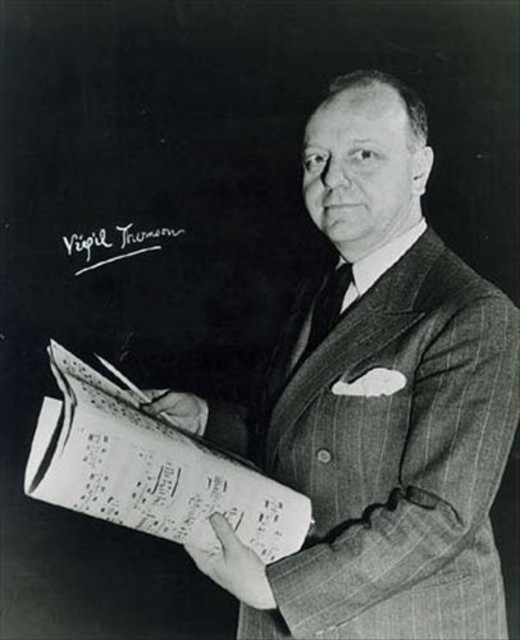
Virgil Thomson
Charts
Tracks
Playlists
Press Mentions
Google Rankings
Overview
Not included in any known risky playlists
Monthly Listeners
Discography
Genres
Spotify has not assigned genres to this artist yet
Top Audiences
Top Listener Locations
 New York City, US44Chicago, US27Washington, US23
 London, GB21Minneapolis, US18
Playlist Summary
Playlist Movement
Event | Playlist | Botted? | Position | Track | Happened at | |
|---|---|---|---|---|---|---|
Biography & Metadata
Perhaps best known for his collaborations with author Gertrude Stein, American composer and music critic Virgil Thomson was born in Kansas City. He began playing piano at the age of five and began taking lessons with local teachers at age 12. He studied organ from 1909 until 1917, and again in 1919. As a young man, Thomson worked as an organist in his family's church of Calvary Baptist, as well as in other churches throughout Kansas City. After attending Central High School from 1908 to 1913, Thomson enrolled at a local junior college, where he studied from 1915 to 1917, and again in 1919. During World War I, Thomson enrolled in the Army, where he served in a field artillery unit. He also received training in radio telephony at Columbia University and in aviation in Texas. The war ended shortly before Thomson was to leave for France. In the fall of 1919, Thomson enrolled at Harvard University, where he met three individuals who would come to have a profound influence on the young musician. The first of these was Edward Burlingame Hill, with whom Thomson studied orchestration and modern French music. Archibald T. Davison was the conductor of the Harvard Glee Club, a group with which Thomson spent three years as assistant and accompanist. Thomson also came into contact with S. Foster Damon, a Blake Scholar who introduced him to the music of Satie and the writings of Gertrude Stein. Thomson began to compose in 1920, while still a student at Harvard. Thomson spent the summer of 1921 touring Europe with the Glee Club. As the tour wound down, Thomson decided to remain, and under a John Knowles Paine Traveling Fellowship, he studied organ with Nadia Boulanger and counterpoint privately. During this time, he continued to compose and had his first critical writings published by the Boston Transcript. Upon his return the U.S., Thomson returned to Harvard and became organist/choirmaster at King's Chapel in Boston. After his graduation from Harvard in 1923, a grant from the Juilliard School allowed him to go to New York, where he studied conducting with Chalmers Clifton and counterpoint with Rosario Scalero. From 1925 to 1940, aside from occasional visits to the U.S., Thomson resided in Paris. It was there, in 1926, that he met Stein. The two began to plan an opera, the result of which is Four Saints in Three Acts, perhaps Thomson's most famous work. For a period of approximately seven years after the composition of Four Saints in Three Acts, Thomson explored the problems of "pure" music as he worked on expanding his technical facility as a composer, especially in regards to writing for string instruments. During the late 1930s, Thomson returned to a more nationalistic vein with the scores to two films, The Plow That Broke the Plain and The River, and a ballet, Filling Station. In October of 1940, Thomson became music critic for The New York Herald Tribune. Although he continued to compose during his 14 years at the post, Thomson established himself as one of the foremost critical writers of the era. His writings, which are characterized by a brilliant and at times deeply provocative, but always highly opinionated whit, furnished material for three anthologies; The Musical Scene, The Art of Judging Music and Music, and Right and Left. Throughout the 1950s and 1960s, Thomson traveled extensively as a guest lecturer, or a conference participant, all the while continuing to conduct, write articles, and compose.
First discovered Oct 8, 2026, 10:06 AM