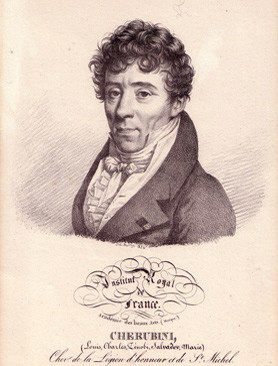
Luigi Cherubini
Charts
Tracks
Playlists
Press Mentions
Google Rankings
Overview
Not included in any known risky playlists
Monthly Listeners
Series
- Monthly Listeners
- Listeners from Playlists
- Change
Discography
Top Audiences
Top Listener Locations
 London, GB1,251
 Madrid, ES644
 Paris, FR634
 New York City, US582
 Istanbul, TR534
Playlist Summary
Playlist Movement
Event | Playlist | Botted? | Position | Track | Happened at | |
|---|---|---|---|---|---|---|
Biography & Metadata
Much admired by musicians, Cherubini was Beethoven's favorite contemporary composer. What Beethoven and many others particularly admired was Cherubini's ability to weave his polyphonic virtuosity, Classical stylistic polish, and a truly Romantic sense of drama into music of extraordinary depth and dramatic power. The work that made Cherubini famous as a dramatist of exceptional psychological acumen was the opera Medée, based on the harrowing tragedy by Euripides. Cherubini also excelled as a church composer. In his sacred music, particularly the later works, he combined his profound knowledge and skill as a contrapuntist with an ability to express the tremendous experience of faith, tempering a passionate dramatic impulse with the discipline of religious contemplation. Born in Florence, on September 14, 1760, Cherubini started studying music with his father; his first work, a mass, was performed in 1773. Five years later, he went to study with Giuseppe Sarti, composing his first opera, Il Quinto Fabio, during this apprenticeship. Returning to Florence in 1782, Cherubini continued composing operas. In 1785, following a successful visit to London, he traveled to Paris, permanently establishing himself in the French capital. His first work for the French stage, the opera Démophoon, was produced in 1788. The following year, which marked the beginning of the French Revolution, Cherubini was named director of a new opera company, an enterprise initiated under the auspices of King Louis XVI's brother, who later ruled France as Louis XVIII. In 1791, Cherubini produced his opera Lodoïska, which was received with tremendous enthusiasm. In 1792, however, the opera company, viewed by revolutionaries as a royalist relic, ceased to exist, and the composer found refuge at a friend's country house in Normandy. Nevertheless, he returned to the capital in 1793, hoping, despite the dangerous political situation, to resume his career. Having made the proper political connections, Cherubini won an appointment at the Institut National de Musique. When the Institute became the Conservatoire National in 1795, he became one of its inspectors. During this period, he composed ephemeral works glorifying the new government. A turning point in Cherubini's career was the 1797 production of Medée. As Philip G. Downs has observed, Medée is a brilliant synthesis of the opéra comique (with spoken dialogue), the tragédie lyrique (with a story from mythology), Gluck's opera, and the allegorical opera during the French Revolution. Medea, the mythological sorceress who murders her children, is traditionally portrayed as a demonic figure. Significantly, Cherubini's work, while conveying the sheer horror of Medea's actions, focuses on the chilling, sinister, yet profoundly human, nature of his protagonist's rage. In 1805, Cherubini traveled to Vienna, where he met Haydn, Beethoven, and Napoleon, who had come to the city as a conqueror. The French emperor, who never fully appreciated Cherubini's music, urged the composer to return to Paris. After his return, Cherubini fell into a deep depression, lost all interest in music, retired to the chateau of the Prince of Chimay, and turned to painting and botany. Fortunately, he was asked to compose a mass for the church in Chimay, and this request prompted him to return to music. His inspiration as powerful as ever, Cherubini devoted himself to composing music for the Church. In 1822, he became director of the Paris Conservatory, gaining the reputation of an excellent administrator. Although extremely busy at the Conservatory, he continued to compose, writing, among other works, his profound Requiem in D minor. First performed in 1836, Cherubini's Requiem was also played at his funeral -- according to his wishes. ~ Zoran Minderovic, Rovi
First discovered Sep 13, 2026, 1:02 PM