John Butcher
Charts
Tracks
Playlists
SEO
Press Mentions
Overview
Not included in any known risky playlists
Monthly Listeners
Discography
Top Audiences
Top Listener Locations
 London, GB11
 Warsaw, PL7
 Mexico City, MX6
 Los Angeles, US5
 Stockholm, SE4
Playlist Summary
Playlist Movement
No activity found
This artist's playlist additions and removals will appear here.
Biography & Metadata
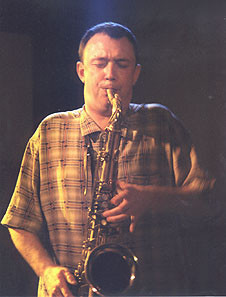
Despite the fact that British saxophonist John Butcher came relatively late to free improvisation, his highly personal sound turned him into one of the key sax players of the late '90s onward. A very busy schedule and an impressive number of music associates have given him the exposure he needed to build a strong following among avant-garde music fans. Drawing from the techniques of Evan Parker and the philosophy of Derek Bailey, he freed his playing of unnecessary stamina to open new directions in the use of overtones and multiphonics. Butcher had in mind to become a physicist and actually began his Ph.D. before turning to music full-time. Self-taught on the tenor and soprano saxophones since the late '70s, he began to play jazz, both conventional and unorthodox, while attending university in Surrey (England). There he met pianist Chris Burn, a musician who remained a frequent partner, and tasted group improvisation for the first time through Stockhausen's intuitive pieces. At the turn of the decade, he moved to London for his Ph.D. and performed in jazz quartets and Burn's big band on the side. In 1982, in his early thirties, Butcher abandoned his thesis on the theoretical properties of charmed quarks and decided to turn professional and to do it in the realm of creative music. Beginnings were rough, especially since the 1980s was not a good decade for experimentalists. He spent those years building friendships and associations with Burn (monthly concerts at the Workers' Music Association), John Russell, and Phil Durrant (a trio formed in 1984) and the group News from the Shed (Russell, Durrant, Radu Malfatti, and Paul Lovens). He released his first album in 1984 (Fonetiks, a duet with Burn) and started his own label, Acta, in 1987. In the 1990s, Butcher split his time between structured improvisations within groups (Chris Burn's ensemble; the London Improvisers Orchestra; Polwechsel, which he joined in 1997), free improv in small groups, and solo work. In 1992, he released his first solo album, Thirteen Friendly Numbers. This release, plus his participation in Georg Graewe's Frisque Concordance and in John Stevens' last version of the Spontaneous Music Ensemble, finally brought him deserved attention from the specialized music press. His output increased and so did his reputation as a fantastic listener in free improv contexts. He became much sought after, appearing in the Phil Minton Quartet, Fred Van Hove's nonet, and dozens of other live projects. A North American tour in 1994 led to much networking with musicians from Chicago and the West Coast. By 1998, Butcher had reached the status of main figure in modern saxophone. Throughout the decade, he perfected his playing, extending his technique and gradually moving away from statistical density to foray into silence and microsound, a tendency easy to pinpoint through his solo recordings Thirteen Friendly Numbers (1992), London & Cologne (1998), and Fixations (14) (2001). His trio with Axel Dörner and Xavier Charles (The Contest of Pleasures, 2001), exploring the inner depths of overtones, marked a new direction. On albums like 2003's Invisible Ear, he experimented with amplified feedback and overdubbing. Also during the decade, he released collaborations with percussionist Gino Robair, double bassist John Edwards, drummer Paal Nilssen-Love, and electro-acoustic improv pioneers AMM, among many others. He also released solo albums The Geometry of Sentiment (2007) and Resonant Spaces (2008). Bell Trove Spools, recorded live in Houston and Brooklyn, was issued by Northern Spy in 2012. The label also released The Natural Order, his 2014 outing with Fred Frith. Live solo albums Live at White Cube and Nigemizu both appeared in 2015, and Butcher remained a prolific collaborator, working with artists such as guitarist Andy Moor, pianist Matthew Shipp, Portuguese group RED Trio, and percussionist Mark Sanders. ~ François Couture, Rovi
First discovered Aug 28, 2026, 8:05 PM