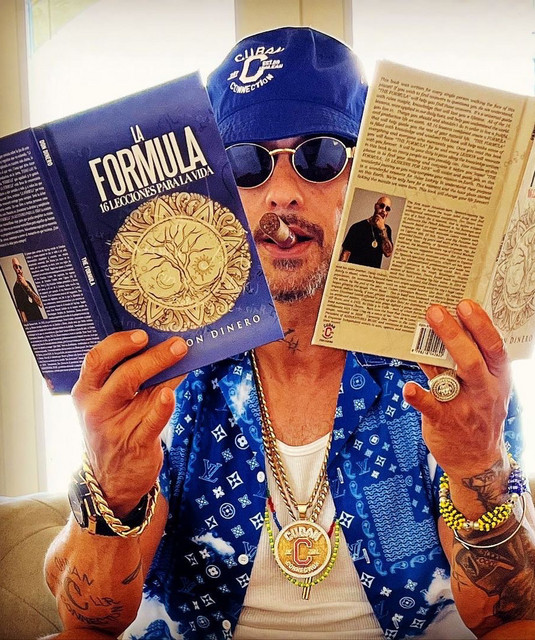
Don Dinero
Charts
Tracks
Playlists
Press Mentions
Google Rankings
Overview
Not included in any known risky playlists
Monthly Listeners
Discography
Genres
Spotify has not assigned genres to this artist yet
Top Audiences
Top Listener Locations
 Bogotá, CO1,359
 Santiago, CL1,176
 Managua, NI1,022
 Guatemala City, GT513
 Mexico City, MX412
Playlist Summary
Playlist Movement
Event | Playlist | Botted? | Position | Track | Happened at | |
|---|---|---|---|---|---|---|
Biography & Metadata
The first major American-born, Spanish-rapping hip-hop artist to make the major-label jump and find widespread commercial acceptance, Don Dinero was one of a kind -- for a moment, that is, before a legion of followers like Pitbull followed in his footsteps and likewise found an eager market for stateside Spanish-language rap. Granted, stateside Latino rappers such as Cypress Hill, Lil Rob, Nore, and Big Punisher had preceded Dinero by years, and south of the border there had long been plenty of Spanish-language rap, for instance, the Mexican hardcore rap of Control Machete or the massive reggaeton movement. But Dinero was different: he was an American who rapped in en español for Spanish-speaking Americans, which set him apart from his aforementioned predecessors and made him a unique presence in the hip-hop world -- and also earned him much respect from American Latinos, who felt he was rapping for them, not for a crossover audience as his American predecessors had. Born Jose Manuel Guitian in the rough Washington Heights section of Manhattan, Dinero found much inspiration amid New York's thriving hip-hop scene. In the late '90s he and his older brother, Oscar Guitian, started their own label, Last Laugh Records, and went about making their dreams come true. Not much came of that venture, unfortunately, and Dinero decided to move himself and his family to Miami, where he believed there was ample opportunity amid the city's huge Latino population. This was in 2002, and he immediately began work on what would become Que Bola! He released the album by the end of the year, on Cuban Connection Records, and Miami's Salsa 98.3 began playing the single "Pana Pana." This in itself was landmark, as the predominantly tropical station rarely, if ever, played so-called urban music, but the best was yet to come, when Universal Latino offered to pick up Que Bola! for distribution, reissuing it in 2003 in an enhanced edition. Universal also green-lighted a group album, Don Dinero & the Revolu All Stars, and a DVD, Su Vida y la Calle -- both of which furthered the quickly mounting buzz surrounding Dinero. Such was the buzz that Dinero and Dinero alone was chosen to collaborate with Celia Cruz on a remix of her "Son de la Loma" single, released in 2004. That year he also independently released a retrospective collection, The Best of Don Dinero, which featured his best-known songs in remixed form. All of this ascension culminated in 2005 with the release of Ahora Que Sí, Dinero's long-awaited follow-up to Que Bola! The album's lead single, "Arte de la Calle," got excessive airplay in the stateside Latino enclaves of Miami, Los Angeles, New York, and Texas, setting up well the album's eventual release in July. ~ Jason Birchmeier, Rovi
First discovered Aug 23, 2026, 10:43 AM