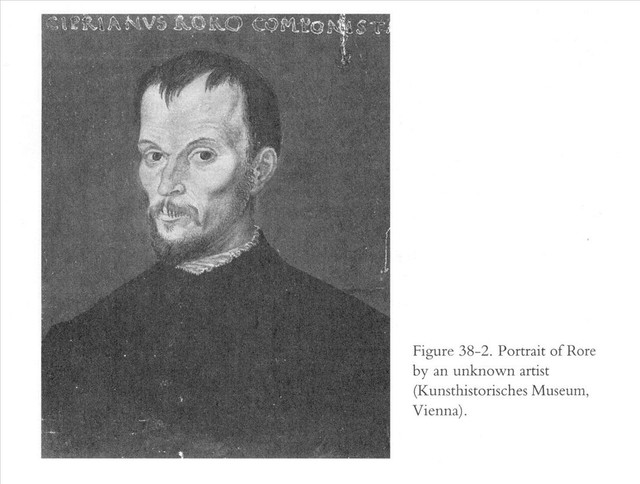
Cipriano de Rore
Charts
Tracks
Playlists
SEO
Press Mentions
Overview
Not included in any known risky playlists
Monthly Listeners
Discography
Genres
Spotify has not assigned genres to this artist yet
Top Audiences
Top Listener Locations
 London, GB93
 Amsterdam, NL56
 Berlin, DE55
 Madrid, ES53
 New York City, US48
Playlist Summary
Playlist Movement
No activity found
This artist's playlist additions and removals will appear here.
Biography & Metadata
He was known while still alive as il divino Cipriano. He directed two of the finest musical chapels in Italy. Aristocrats across Europe -- the Emperor Charles V, the Count of Egmont, Duke Albrecht V of Bavaria -- asked him to compose for them. His music not only provided one of the first single-composer madrigal prints ever, but it was also republished after his death for an astonishing 40 years. A generation of madrigal composers looked to him for inspiration, and no less a figure than Giulio Cesare Monteverdi named him as innovator of the secunda prattica, the foundation of the Baroque style. This was Cipriano de Rore, truly a musical legend in his own time. Rore was born to a minor noble family in Flemish Ronse (Renaix). Very little information survives about his early education, musical or otherwise. By 1542, however, he had moved from the Low countries to Italy (specifically Brescia), seeking musical fame. He might have studied with Willaert at Venice's San Marco; he quickly became familiar with the man and his "circle." By the early 1540s, he was already composing heavily in both motets and madrigals; the dedications of several works indicate his ambition to serve some great Italian court. In 1546, he won the prestigious job of chapelmaster to Duke Ercole II d'Este of Ferrara. For decades Este Ferrara and nearby Mantua had maintained some of the finest musicians of the Renaissance; Rore's appointment secured him a highly visible position. He rose to the challenge, composing nearly half of all his extant music in the first decade of Ferrarese employment. Fully five books of his madrigals date from this period, including works in which his style shifted toward more radical and chromatic text-painting devices. This later Ferrarese style cemented Rore's European fame, as well as his influence upon a new generation. In 1558, however, Rore seems to have attempted to resign from court life. He received permission to travel back to his hometown, though the town had been razed during a recent war. He lost his job in Ferrara upon the Duke's death, replaced it briefly with work for the smaller Farnese court of Parma, and finally took over the late Willaert's prestigious Venetian post of maestro di cappella for San Marco in 1563. Unfortunately, this employment failed for unknown reasons, and Rore returned to Parma in 1564. He died shortly thereafter, his reputation happily untarnished.
First discovered Aug 23, 2026, 5:20 AM