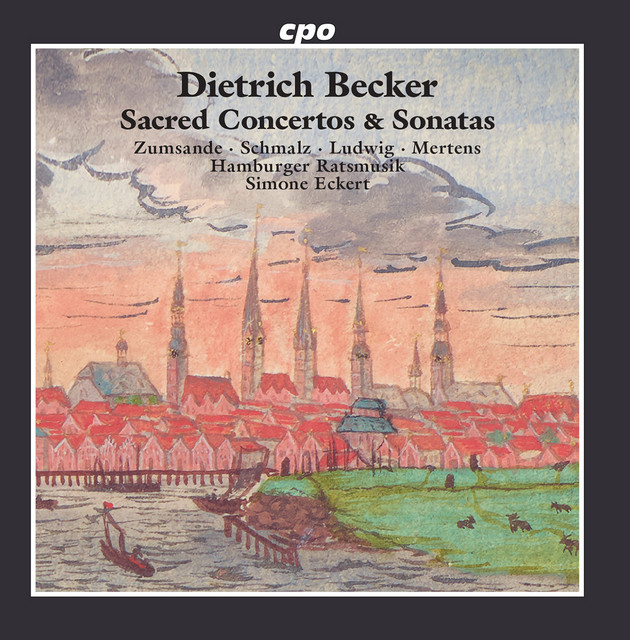
Dietrich Becker
Charts
Tracks
Playlists
Press Mentions
Google Rankings
Overview
Not included in any known risky playlists
Monthly Listeners
Series
- Monthly Listeners
- Listeners from Playlists
- Change
Discography
Genres
Spotify has not assigned genres to this artist yet
Top Audiences
Top Listener Locations
 Madrid, ES22
 London, GB19
 Amsterdam, NL19
 New York City, US16
 Berlin, DE15
Playlist Summary
Playlist Movement
Event | Playlist | Botted? | Position | Track | Happened at | |
|---|---|---|---|---|---|---|
Biography & Metadata
Dietrich Becker was a talented instrumentalist and influential composer in Hamburg in an era when Dietrich Buxtehude dominated North German music. Becker's origins and early life are still unclear, but it would seem that he was probably born in Hamburg. He first appears in a professional capacity as organist to Count Rantzau at the castle chapel in Ahrensburg. Although first appointed as an organist, Becker became best known as a fine violinist. It was the latter instrument that he played as a member of the court ensemble of Count Magnus Gabriel de la Gardies just outside Stockholm from 1654-1655 and also at the court of Duke Christian Ludwig of Celle from 1656. In 1662 Becker was given permission by the court at Celle to improve his skill by means of a visit to the North German port city of Hamburg. He never returned to Celle, but instead became heavily involved in the musical life of Hamburg, becoming a citizen on April 11, 1662. Despite his success he was not given a salaried appointment until July 1667 when he succeeded Johann Schop. In 1668 Becker added to his duties the role of director of the town's musicians; the combination of his duties meant that he had performed in almost every secular and sacred event and venue of note in Hamburg. He almost certainly became involved the rapidly growing Hamburg opera during this time as well. In 1674 Becker also took over running the choirs of the towns two main churches as well as directing the "kleine Canonicat" at the Cathedral. As part of his duties at the Cathedral, Becker composed a popular setting of the "Passion According to St. John" -- sadly now lost. Considering his activities as a violinist it is not surprising that the bulk of his instrumental music features that instrument -- though curiously no solo violin works by him survive. His Musicalishe Frülings-Früchte (Hamburg, 1668) and the two volumes of Sonaten and Suiten (Hamburg 1674 and 1679) are among his finest collections. In addition to the fine and idiomatic writing for the violin, some of the pieces also contain accomplished parts for the viola da gamba. It has also been pointed out that Becker may have been the first composer to popularize the standard suite sequence of Allamand-Courante-Sarabande-Gigue that would dominate instrumental music for the next century.
First discovered Aug 26, 2026, 9:38 AM