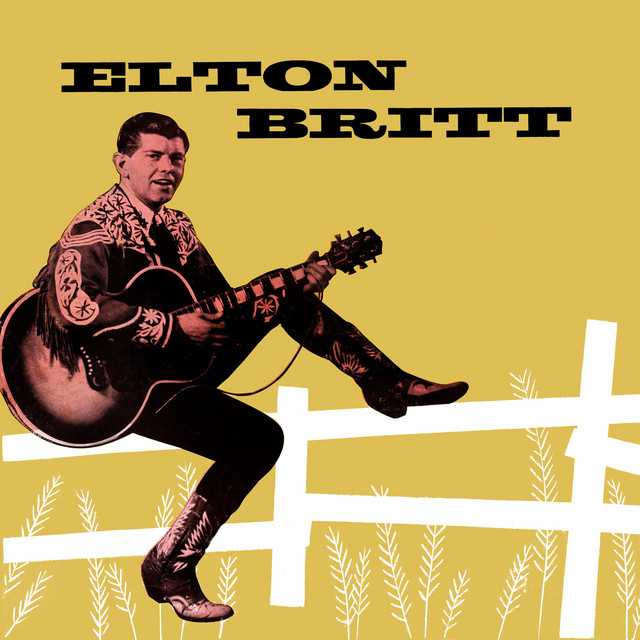
Elton Britt
Charts
Tracks
Playlists
Press Mentions
Google Rankings
Overview
Included in high risk playlists
Monthly Listeners
Series
- Monthly Listeners
- Listeners from Playlists
- Change
Discography
Top Audiences
Top Listener Locations
 Chicago, US3,447Dallas, US3,042Los Angeles, US2,853
 London, GB2,809
 Sydney, AU2,326
Playlist Summary
Playlist Movement
Event | Playlist | Botted? | Position | Track | Happened at | |
|---|---|---|---|---|---|---|
Biography & Metadata
Elton Britt parlayed his Jimmie Rodgers imitation -- with a yodeling ability and range that surpassed Rodgers' -- into country's biggest hit of the World War II era, "There's a Star Spangled Banner Waving Somewhere," which sold four million copies in the early '40s. He was born James Britt Baker in Zack, AR, on June 27, 1913, and began playing guitar and singing around his hometown while in his mid-teens. Baker's career was made in 1930 when the Beverly Hill Billies returned from California to their Arkansas home to recruit a new vocalist. He won the talent search, and after being renamed Elton Britt, spent three years performing and recording with the Hill Billies. Britt moved to New York in 1933, initially playing in a quartet named Pappy, Zeke, Ezra & Elton. He recorded later in the '30s, as a solo act and also with the Wenatchee Mountaineers, Zeke Manners' Gang, and the Rustic Rhythm Trio. Britt began his period of fame in 1939, thanks to two circumstances: his signature on a contract for the discount label RCA Bluebird and -- most importantly -- his friendship with songwriter/producer Bob Miller. Miller wrote all of Elton Britt's greatest early hits, including "Chime Bells," "Rocky Mountain Lullaby," "Buddy Boy," "Driftwood on the River," and in 1942, "There's a Star Spangled Banner Waving Somewhere." The latter was adopted as a symbol of the war effort by patriotic audiences -- much as "Over There" had served World War I sympathizers. President Franklin Roosevelt even invited Britt -- billed as "the World's Highest Yodeler" -- to the White House in 1942 to perform the hit. By the time the charts came into existence in 1944, though, Britt had peaked. He did hit the Country Top Ten 11 times during the last half of the '40s, but never topped the charts. "Someday" reached number two in 1946, and six other songs peaked in the Top Five, including the double-sided "Wave to Me, My Lady"/"Blueberry Lane," "Detour," "Gotta Get Together With My Gal," "Candy Kisses," and "Quicksilver." A re-recording of his early hit "Chime Bells" hit number six. Britt continued recording with RCA, eventually releasing over 50 albums until 1957, when he moved to ABC/Paramount. He made a brief bid for the presidency in 1960, and recorded the number 26 "Jimmie Rodgers Blues" eight years later, but retired soon after. He died on June 22, 1972. ~ John Bush, Rovi
First discovered Jun 21, 2026, 12:18 AM