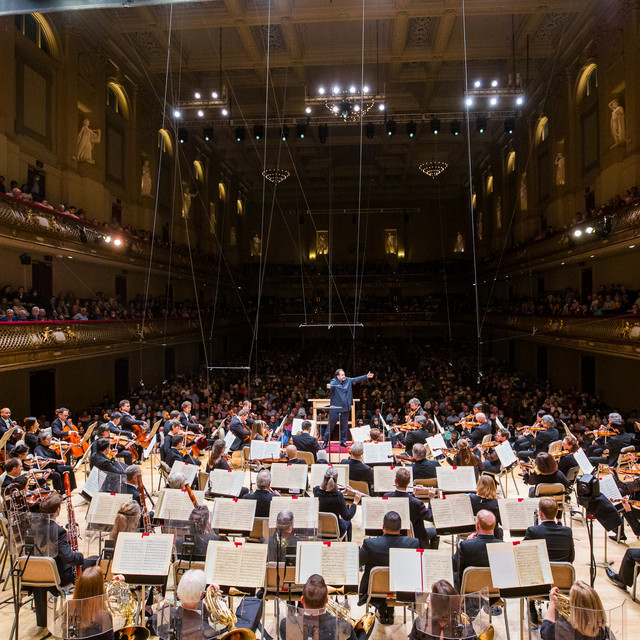
Boston Symphony Orchestra
Charts
Tracks
Playlists
SEO
Press Mentions
Overview
Not included in any known risky playlists
Monthly Listeners
Discography
Genres
Spotify has not assigned genres to this artist yet
Top Audiences
Top Listener Locations
 London, GB16,312
 Mexico City, MX14,402
 Madrid, ES13,827
 Santiago, CL12,293
 São Paulo, BR9,827
Playlist Summary
Playlist Movement
No activity found
This artist's playlist additions and removals will appear here.
Biography & Metadata
The Boston Symphony Orchestra is one of the most prominent U.S. symphonic ensembles, with deep roots in the Germanic practices that formed the model for American orchestral culture. The orchestra's catalogue of recordings on the RCA Victor label in the middle of the 20th century, artistically ambitious and sonically top-notch thanks to the ambiance of Boston's magnificent Symphony Hall, continue to set a standard. The Boston Symphony Orchestra was formed in 1881 with principal support from banker Henry Lee Higginson, who also spearheaded the construction of Symphony Hall and its opening in 1900. Its membership consisted largely of German-trained musician, and its first conductor, George Henschel, was a friend of Brahms. Subsequent conductors were German or, in the case of Arthur Nikisch, Hungarian. Especially important was Karl Muck, a former conductor of the Berlin Court Opera (now the Berlin State Opera), who led the orchestra from 1906 to 1908, and again from 1912 to 1918 after the leadership of Max Fiedler in the interim. Muck stepped down and was held in an internment camp in Georgia after espousing pro-German sympathies during World War I. But beginning with Pierre Monteux in 1919, the Boston Symphony boasted a series of internationally renowned and non-German conductors. Monteux was French; Serge Koussevitsky, who led the orchestra from 1924 to 1949, was Russian and a towering figure who commissioned numerous modern works and led the world premieres of Stravinsky's Symphony of Psalms and Bartók's Concerto for Orchestra, among many other now-standard works, and founded the annual Tanglewood Music Festival and its associated talent-development classes, with the BSO in residence. Koussevitsky was succeeded by Alsatian-French Charles Münch (1949-1963) and the Austrian-Jewish Erich Leinsdorf, whose RCA recordings were central to collections in the LP era in the U.S. Leinsdorf was succeeded for several years by the ailing William Steinberg and in 1973 by Japanese-born Seiji Ozawa, whose leadership was artistically controversial but long, and also marked by significant recordings, mostly on the Deutsche Grammophon label. Another conductor with an operatic background, James Levine, followed Ozawa in 2002; he stepped down due to ill health and Latvian conductor Andris Nelsons, who had taken on Mahler's vast Symphony No. 8 ("Symphony of a Thousand") as an emergency replacement for Levine, was named conductor. His contract has been extended through 2022, and he has led the orchestra in new recordings with Deutsche Grammophon, including a live cycle of the symphonies of Dmitri Shostakovich. A notable feature of the orchestra's musical life is the existence of the Boston Pops light music orchestra, with personnel drawn from the ranks of the BSO; under conductor Arthur Fiedler (son of Max), that group attained unprecedented popularity on American radio and television as well as in live concerts. The Boston Symphony Orchestra has also been heard on the scores of two films by director Steven Spielberg, Schindler's List and Saving Private Ryan, with the scores' composer, John Williams, as conductor.
First discovered Aug 20, 2026, 6:49 PM