Jacques Hotteterre
Charts
Tracks
Playlists
SEO
Press Mentions
Overview
Not included in any known risky playlists
Monthly Listeners
Discography
Genres
Spotify has not assigned genres to this artist yet
Top Audiences
Top Listener Locations
 Paris, FR62
 Santiago, CL44
 London, GB41
 Mexico City, MX39
 Madrid, ES38
Playlist Summary
Playlist Movement
No activity found
This artist's playlist additions and removals will appear here.
Biography & Metadata
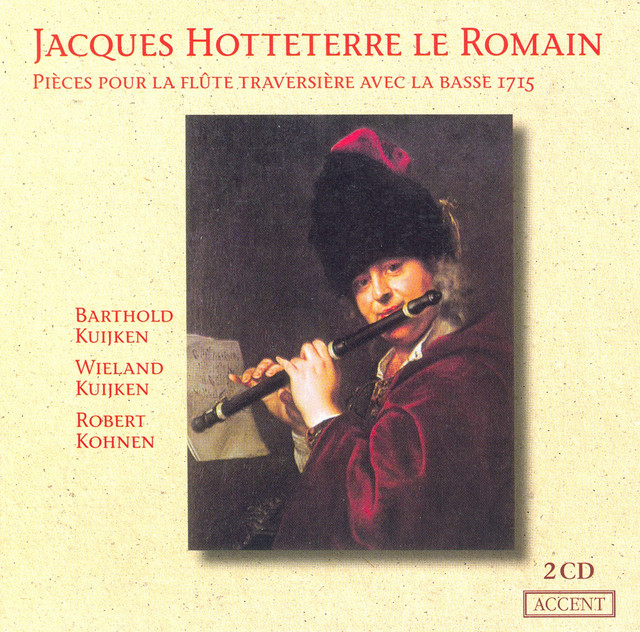
Jacques-Martin Hotteterre was a member of a long and distinguished dynasty of Burgundian instrument-makers and performers, several generations of which played at the King's court. He was known as "Le Romain," possibly because, unlike others of his immediate family, he had visited Rome. He was primarily a practicing musician and a dedicated teacher. Little else is known about his life, and even the dates of his birth and death are disputed. Thus Hotteterre might well have joined the legion of anonymous masters had it not been that, in addition to his musical talents, he lived during a period of great artistic and cultural expansion, and was prominent in both the development and playing of woodwind instruments that took place in Europe -- particularly in France -- from the beginning of the eighteenth century. Hotteterre was also a respected figure in the musical activities of the Versailles court of King Louis XIV where, after succeeding his father as a member of the King's "hautbois et violons de la Grand Écurie", he played oboe and bass viol and held the title of "Ordinaire de la Musique du Roi." It has been said that his services were more highly rewarded than were the best organists of the time. Hotteterre's present reputation lies mainly in having written important instructional treatises on the (then newly designed) three-section, single-keyed wooden flute we now call the Baroque flute. His Principes de la Flûte and more extended L'art de Préluder sur la Flûte Traversière.... " (1712) are among the most detailed sources of information on the styles and technique of flute-playing during the French Baroque, and include chapters and fingering charts for the oboe and alto recorder. He also wrote an instructional method for the musette, a small French bagpipe then being adopted for pastoral effect by composers at the Royal Court in Versailles. Hotteterre's compositions -- principally for transverse flutes, recorders and oboes -- possess all the elegance, invention, and exuberance of the period, with the added advantage that they contain signs and notations showing exactly what would then have been expected of accomplished players, and are, therefore, instructive to present-day students of eighteenth century French woodwind music in matters of interpretation and embellishment.
First discovered Aug 18, 2026, 5:52 AM