Nikolai Myaskovsky
Charts
Tracks
Playlists
SEO
Press Mentions
Overview
Not included in any known risky playlists
Monthly Listeners
Discography
Genres
Spotify has not assigned genres to this artist yet
Top Audiences
Top Listener Locations
 New York City, US65
 London, GB63
 Mexico City, MX44
 Sydney, AU39
 São Paulo, BR38
Playlist Summary
Playlist Movement
No activity found
This artist's playlist additions and removals will appear here.
Biography & Metadata
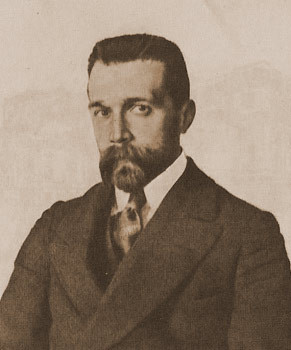
Nikolay Myaskovsky was an influential Russian composer and educator during the first half of the 20th century. He received several awards and acknowledgments for his achievements, including five Stalin Prizes and an honorary doctorate from the Moscow Conservatory. Myaskovsky was born in 1881, in the Russian military-occupied Modlin Fortress in Poland. His father was an engineer who worked for the Russian military and also taught at the Military and Engineering Academy in St. Petersburg. As a boy, Myaskovsky received training on both the piano and the violin, but he was ultimately expected to follow the family tradition of joining the military. After his mother died in 1890, he was raised by his aunt, who formerly worked as a singer at the St. Petersburg Opera, and she encouraged him to explore music. He was educated in Russian military schools, which eventually included the academy where his father taught. In addition to his academic responsibilities, Myaskovsky also sang in the military cadet choir, played in the orchestra, and continued his violin and piano lessons. After he finished his military training in 1902, he began working in a battalion of engineers in Moscow, and he studied harmony with Reinhold Gliere, who also encouraged Myaskovsky to consider changing his career to music. In the fall of 1903, he was transferred to St. Petersburg, and he started lessons in orchestration and form with Ivan Krïzhanovsky, a former student of Nikolai Rimsky-Korsakov. In 1906 Myaskovsky resigned from his position with the engineering battalion and enrolled at the St. Petersburg Conservatory, where his professors were Anatol Lyadov, Rimsky-Korsakov, and Jāzeps Vitols. He became friends with Sergey Prokofiev, who was also a student at the conservatory. In his third year, Myaskovsky composed his Symphony No. 1, which won a scholarship that paid for the remainder of his schooling. After his graduation in 1911 he became a popular music journalist, taught private lessons, and composed. World War I removed him from his career, and he was recalled into the Russian military and sent to Austria. He fought there for three years, and then he was stationed in Estonia as an engineer for the final year of the war. The October Revolution in Russia extended Myaskovsky's time in the military, but he resumed composing around 1917. After he was finally discharged in 1921, he accepted a teaching position at the Moscow Conservatory. Myaskovsky became internationally known as a composer in the mid-'20s, as his fifth and sixth symphonies were being performed outside of Russia. Throughout the 1930s and '40s, he continued composing symphonies, piano sonatas, and string quartets. Over his almost 30-year-long career at the Moscow Conservatory, he became highly sought-after as an educator. Some of his more prominent students included Aram Khachaturian, Dmitri Kabalevsky, and Vissarion Shebalin. Through his selfless promotion and encouragement of his students and colleagues, he was often referred to as "the musical conscience of Moscow." Myaskovsky remained active until months before his death from cancer in 1950. His works have been recorded by Idil Biret, Mstislav Rostropovich, and more recently by Vasily Petrenko and the Oslo Philharmonic Orchestra. ~ RJ Lambert, Rovi
First discovered Aug 22, 2026, 10:56 PM