Joseph Boulogne Chevalier de Saint-Georges
Charts
Tracks
Playlists
SEO
Press Mentions
Overview
Not included in any known risky playlists
Monthly Listeners
Discography
Genres
Spotify has not assigned genres to this artist yet
Top Audiences
Top Listener Locations
 Mexico City, MX2,897
 London, GB2,775
 Madrid, ES2,084
 São Paulo, BR1,823
 Sydney, AU1,775
Playlist Summary
Playlist Movement
No activity found
This artist's playlist additions and removals will appear here.
Biography & Metadata
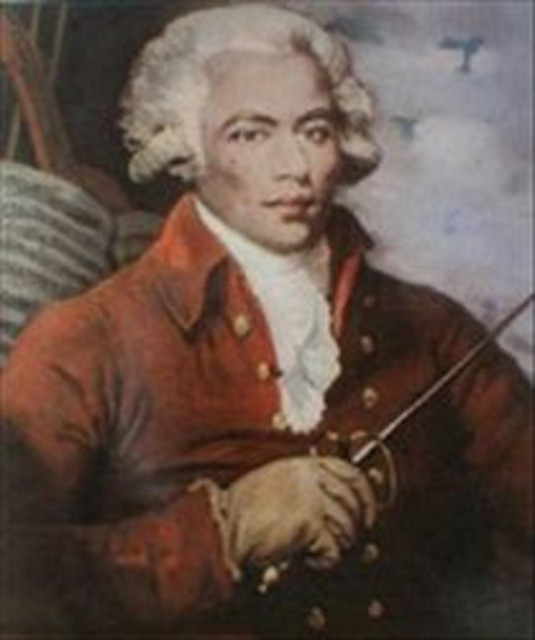
Joseph Boulogne, more commonly known as Saint-Georges, was born about 1739, in Basse Terre, Guadeloupe. His father was a French Parliamentary councilor. Little is known about Boulogne's mother, who came from Africa, and no known records survive as to her early history. His earliest upbringing was in the isles of the Caribbean. While he was young, his family moved to Saint Domingue (now Haiti); it was there that he likely had his first violin lessons, under the direction of his father's plantation manager. When he was 10, the family once again shifted its home, this time to Paris, France. In Paris, Boulogne's life underwent an almost phenomenal change. He not only partook in a wide range of activities -- including riding, dancing, swimming, skating, and fencing -- he became a master swordsman, often being deemed the greatest in Europe during his prime. He also studied arms under the Master of Arms La Boessiére for about six years. Before he turned 20, Boulogne took up studies of the violin under Leclair, and composition under Gossec. The years from 1758 to 1768 were filled with learning and mastering both musical creation and performance on his instrument of choice, which he soon mastered as securely as he did fencing. In 1769, Gossec appointed Boulogne as first violinist of the Concerts des Amateurs, the young composer's first professional post. But the real glory came later, in 1772, when he made his debut as soloist in performing his own Op. 2 violin concerti. These violin concerti contain virtuosity that was extreme during this time, but the audience was most impressed with the feeling and expression Boulogne put into his performances. His musical output during this time included assorted sonatas, string quartets, seven Sinfonie Concertanti, a ballet (L'amant Anonime), and two operas (Ernestine and La fille-garçon). By 1773, Boulogne was a well-respected musician, and took over Gossec's post as director of the Concerts des Amateurs. His 1775 appointment as director of the Paris Opéra, unfortunately, was revoked after singers refused to work with him because of his race. However, he was largely responsible for the commissioning of Franz Josef Haydn's famous Paris Symphonies. When the Revolution broke out in 1789, the now-noble Joseph Boulogne, Chevalier de Saint-Georges, joined the newly formed Republic and assembled a new military force in northern France. In 1791, he left music completely and became the captain of the National Guard in Lille. However, Saint-Georges was wrongfully accused of misappropriation of funds intended for the troops, and he was stripped of his command and placed into prison. Upon his release, he left France for Saint Domingue after hearing of the slave rebellion. Saint-Georges returned to Paris in 1797 to resume his musical career, directing a new musical organization, Le Cercle de l'Harmonie. After two dreary years, Saint-Georges died a pauper, having given up his wealth and life to the Revolution and not being able to recover. Saint-Georges is noted as being able to use one excellent melodic line after another in a single work. His thematic ideas seemed endless and effortless, and sometimes he employs so many fine passages in a row that it almost seems wasteful. Apparently, however, he never had to concern himself with exhausting his wealth of musical creativity. He is remembered mainly for his quartets and violin concerti, but his operas were quite popular. His musical style was naturally suited to operatic and theatrical music, and it is believed that some other operatic works of his have been lost to time.
First discovered Aug 21, 2026, 10:13 AM